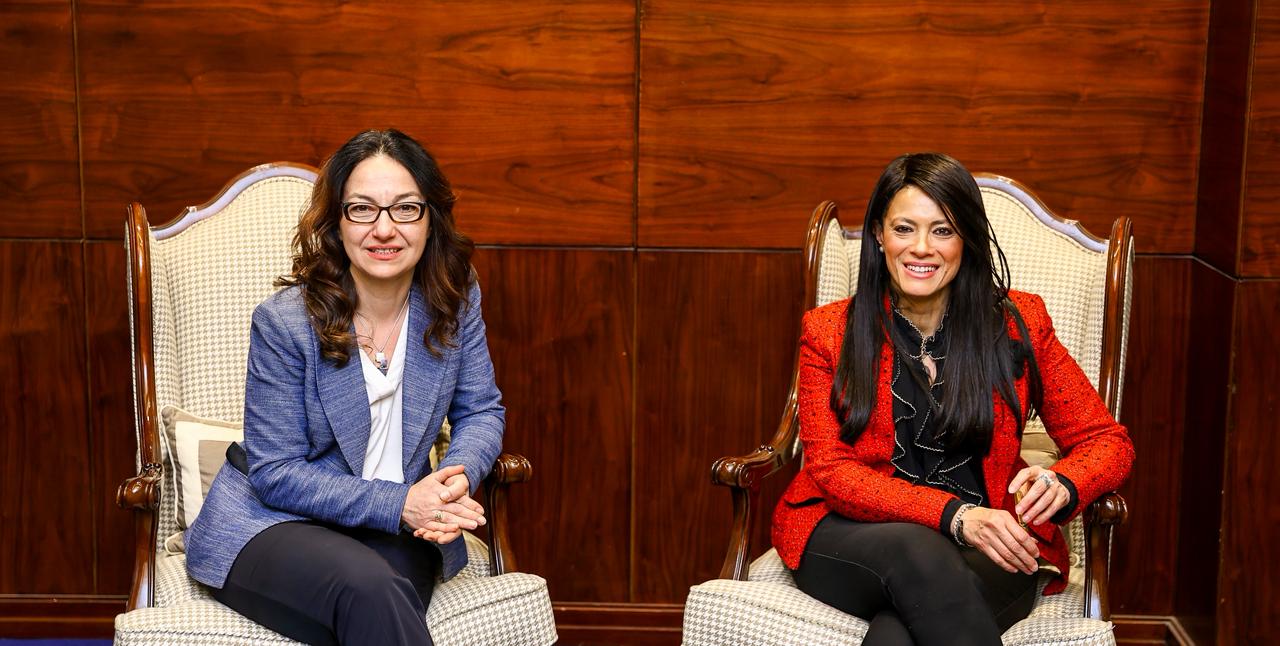
H.E. Dr. Rania Al-Mashat, Minister of Planning, Economic Development and International Cooperation, received a World Bank delegation headed by Ms. Gallina Andronova Vincelette, Vice President for Operations Policy and Country Services at the World Bank Group. The meeting focused on reviewing key areas of cooperation between Egypt and the World Bank Group. The meeting was attended by Maria Sarraf, Regional Director for Environment, Natural Resources, and the Blue Economy for the Middle East and North Africa, Afghanistan and Pakistan, Stephan Gimbert, World Bank Regional Director for Egypt, Yemen, and Djibouti, along with members of the Bank’s technical team.
The two sides discussed several cooperation files, including the Greater Cairo Air Pollution Management Project (GCCC), which aims to reduce air and climate emissions from key sectors while enhancing resilience to air pollution in Greater Cairo. The project is financed by USD 200 million from the World Bank, in addition to a USD 9.3 million grant from the Global Environment Facility (GEF). H.E. Dr. Al-Mashat underscored the importance of private sector participation as a central and catalytic pillar of Egypt’s development agenda, in line with Egypt’s Narrative for Comprehensive Development: Reforms for Growth, Jobs & Resilience.
Discussions also covered the Foreign Direct Investment (FDI) Strategy, the Business Ready (B-Ready) Report, the Blue Economy Strategy, as well as the Climate Investment Funds (CIF) Initiative – the Nature, People, and Climate Investment Program (NPC). Egypt has been selected to participate in the program, with a focus on climate-smart agriculture, agri-business, and coastal ecosystems.
During the meeting, H.E. Dr. Al-Mashat noted that Egypt is one of the founding members of the World Bank and the third-largest contributor within the Middle East and North Africa region. She emphasized the depth of the longstanding partnership between Egypt and the World Bank Group, which dates back to 1959, highlighting its significant contribution to Egypt’s social and economic progress and its tangible impact on the lives of millions of citizens.
H.E. Dr. Al-Mashat also addressed Egypt’s Narrative for Comprehensive Development: Reforms for Growth, Jobs & Resilience, explaining that it serves as an integrated framework linking ambition, policy, and implementation, guided by a shared vision to achieve sustainable and inclusive growth that drives economic transformation and improves quality of life. She stressed that the Narrative aligns with national priorities, updated sectoral strategies, and ongoing reform efforts, while presenting a people-centered economic model aimed at sustaining economic reform with a stronger focus on high-productivity and tradable sectors.
She added that the green transition represents a core pillar of the Narrative, embedding environmental sustainability across Egypt’s growth trajectory in all sectors, including urban development, water, energy, agriculture, industry, transport, infrastructure, and biodiversity. The approach emphasizes climate-resilient cities, sustainable resource management, low-carbon growth, climate-smart practices, and strengthened resilience to climate risks.
She further highlighted the World Bank’s role as a key knowledge partner in the development of the Narrative, noting that more than 100 experts contributed through six specialized working groups. She explained that the Narrative includes a medium-term action plan with clear key performance indicators (KPIs) for all ministries and government entities and is set to integrate with the adoption of a national integrated financing strategy for development, linking the Narrative to performance-based budgeting.
H.E. Dr. Al-Mashat also reviewed the main pillars and indicators of the 2025/2026 Economic and Social Development Plan, which targets investments of EGP 3.5 trillion for the first time, with private sector investments accounting for 63% of total investments, compared to 37% for public investments, while adhering to a ceiling on public investment as part of governance and public expenditure rationalization efforts.
Regarding Development Policy Financing, H.E. Dr. Al-Mashat noted that the government and the World Bank have agreed on a development policy matrix aligned with the government’s structural reform agenda. The matrix addresses three main pillars: enhancing economic competitiveness by increasing competition and improving the business environment to expand private sector participation; building fiscal and macroeconomic resilience to external shocks; and supporting the green transition by strengthening climate adaptation, promoting low-carbon development, expanding renewable energy, and improving efficiency in electricity, water, and sanitation services.