Dr. Rania Al-Mashat:
• The private sector is not merely an implementer of works or services, but a key partner in achieving development.
• Advancing partnerships between multilateral development banks and contractors to enhance the effectiveness of procurement mechanisms for development-bank-financed projects.
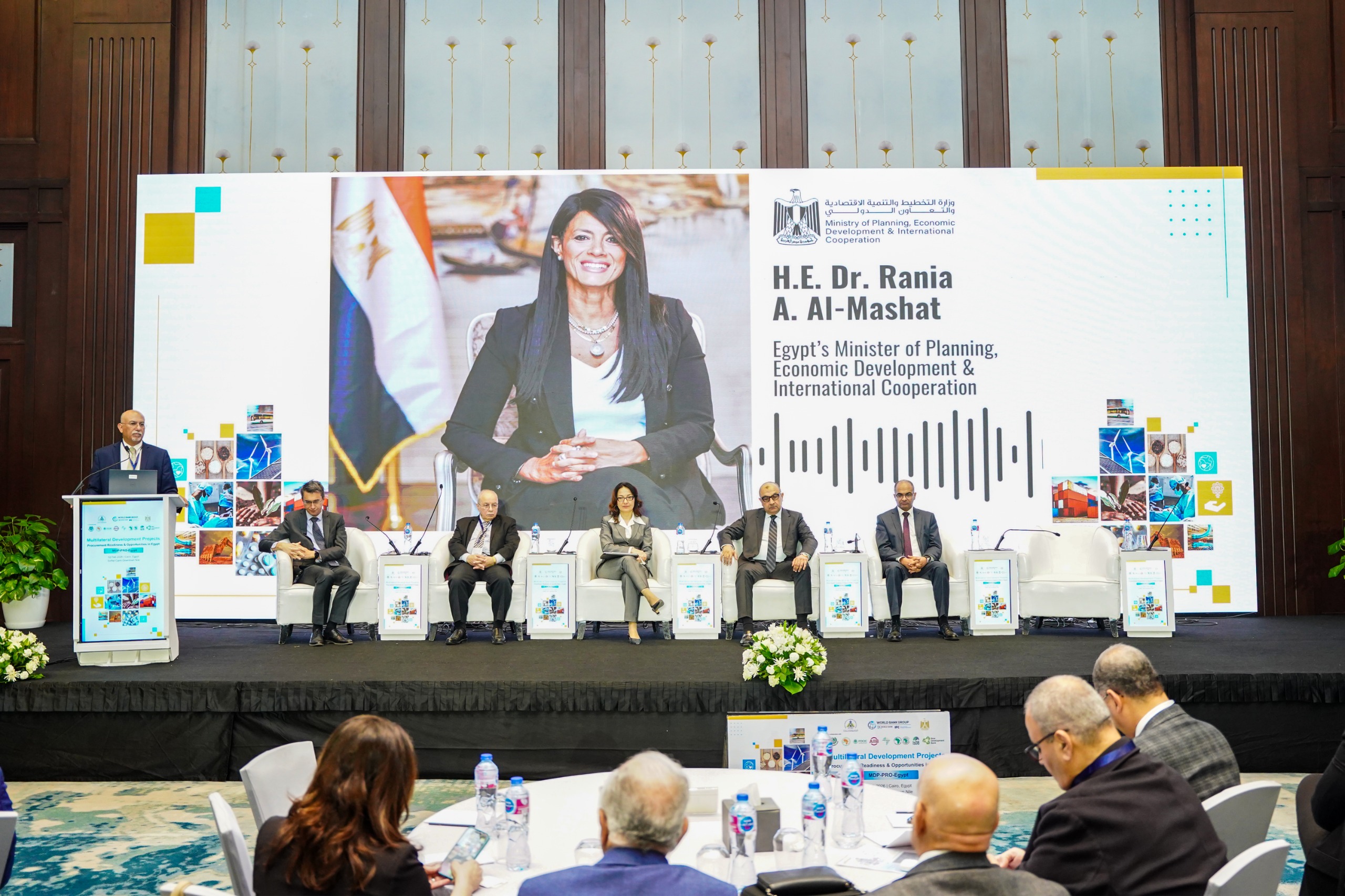
H.E. Dr. Rania Al-Mashat, Minister of Planning, Economic Development and International Cooperation, participated in a seminar on business opportunities, organized by the World Bank and its partner international banks in cooperation with the Egyptian Federation for Construction and Building Contractors.
The Business Outreach Seminar (BOS) was under the title “Multilateral Development Projects: Procurement Readiness and Opportunities in Egypt – MDP-PRO-Egypt.”
The event was attended by Eng. Mohamed Shimi, Minister of Public Business Sector; Dr. Sayed Ismail, Deputy Minister of Housing; Mr. Stephane Guimbert, World Bank’s Country Director for Egypt, Yemen, and Djibouti; and representatives of the private sector.
At the outset of her speech, H.E. Dr. Al-Mashat emphasized that the seminar provides a direct, practical platform linking development finance with government priorities and the private sector’s implementation capabilities. She expressed her appreciation to partners from the World Bank Group, the African Development Bank (AfDB), the African Export-Import Bank (Afreximbank), the Asian Infrastructure Investment Bank (AIIB), the Islamic Development Bank (IsDB), the New Development Bank (NDB), and the Arab, African, and Egyptian federations of contractors for organizing this joint forum.
H.E. Dr. Al-Mashat pointed out that, in recent years, Egypt has succeeded in building one of the most diversified portfolios of multilateral development cooperation in the region. These partnerships support Egypt’s national priorities in infrastructure, human development, climate action, and private-sector-led growth. She noted that while efficiency in mobilizing concessional finance has improved, the real challenge today lies in implementation readiness. Delays in procurement procedures mean delays in services and postponed investments. She stressed that procurement readiness is not merely a procedural matter, but a core development issue.
H.E. Dr. Al-Mashat added that this forum responds directly to this challenge by addressing issues of competition, transparency, and participation in procurement processes. It provides a unified platform for contractors, consultants, and suppliers to engage with multilateral development banks, benefit from lessons learned from common mistakes in bids and proposals, prepare for updated policy changes and procurement guidelines, and better understand procurement mechanisms for future development-bank-financed projects.
H.E. Dr. Al-Mashat further noted that this approach reflects a shift from fragmented engagement to structured dialogue, early visibility, and predictability—all essential elements for building trust and increasing participation, particularly among new and qualified companies.
On the importance of the private sector as a development partner, H.E. Dr. Al-Mashat stated that Egypt’s development agenda relies on a strong, capable, and competitive private sector. The private sector is not merely an executor of works or services; it is a partner in achieving development outcomes through the innovation, efficiency, technologies, and implementation capacities it provides.
In this context, H.E. Dr. Al-Mashat highlighted the launch of the “HAFIZ” (Hub for Advisory, Finance, and Investment for Enterprises) platform by the Ministry of Planning, Economic Development and International Cooperation in December 2023 to provide financial and technical support to the private sector. The platform aims to connect companies, especially small, medium, and start-ups, with international development partners, facilitate access to development finance, technical assistance, advisory services, and internationally funded tenders.
H.E. Dr. Al-Mashat reaffirmed that the “HAFIZ” platform now includes more than 90 financing and technical assistance instruments offered by over 50 international partners, and has attracted nearly 50,000 users from entrepreneurs and the private sector since its launch. It also features a database of more than 700 companies that have benefited from its services and provides access to over 2,500 tenders for development projects in Egypt and more than 80 other countries, enhancing the integration of local companies into global markets.
The Minister of Planning, Economic Development and International Cooperation also emphasized that Egypt is working to transform its economic model through “Egypt’s Narrative for Comprehensive Development” which positions the private sector as a primary engine of national growth and aims to raise the private sector’s share of total investments to 72% by 2030. In this context, the government is implementing legislative reforms, expanding the state’s exit from certain activities, and supporting manufacturing, technology, and renewable energy sectors to enhance job creation and sustainable growth.
Concluding her speech, H.E. Dr. Al-Mashat stated that this forum reflects a shared responsibility among multilateral development banks, which provide concessional finance, global standards, and technical expertise, the government, which offers strategic direction, coordination, and enabling frameworks, and the private sector, which delivers tangible results on the ground. She reiterated that through this partnership, it is possible to ensure that development projects are executed on time and with a sustainable impact.