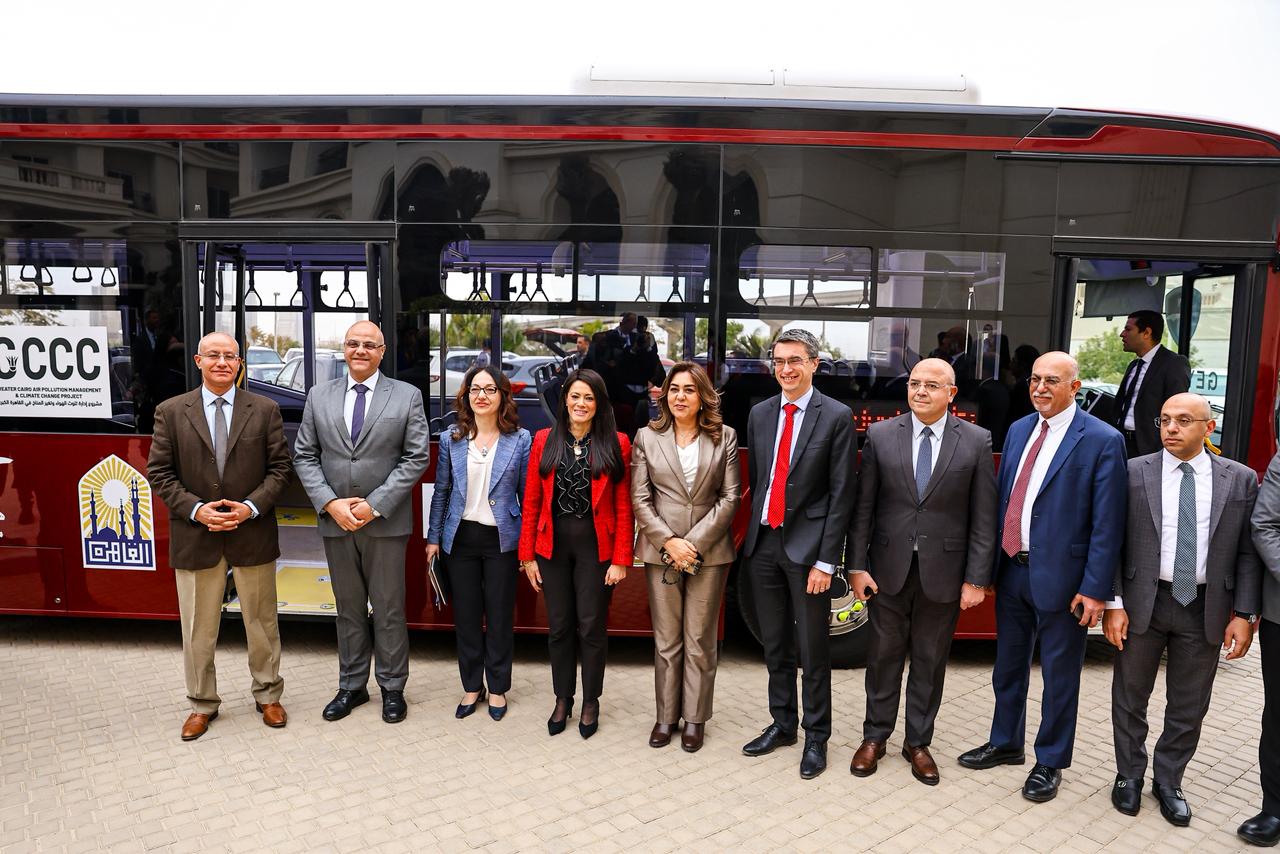
The two ministers witness the pilot operation of one electric bus as part of the project to procure 100 electric buses.
Minister of Planning, Economic Development and International Cooperation:
• The second edition of Egypt’s Narrative for Comprehensive Development is the result of expanded dialogues with various stakeholders and includes a full chapter on the green transition, covering the legislation and policies required to support this shift.
• As the state seeks to reduce emissions, it places people and citizens at the heart of the development process, recognizing that improving public health and increasing productivity are among the most important objectives of the green transition.
• Egypt’s Narrative included the spatial planning pillar and the integrated solid waste management file, reflecting the efforts being made on the ground in cooperation with the governors.
• The partnership between Egypt and the World Bank extends back to 1959 and includes more than 200 projects across various development sectors.
Minister of Local Development and Acting Minister of Environment:
• The project is a comprehensive national initiative to improve air quality, address climate change, and protect citizens’ health in Greater Cairo.
• Tangible progress has been achieved in air quality monitoring, waste management, low-emission transport, and the creation of green jobs.
• We seek to maximize the environmental, health, and economic returns of this vital project.
H.E. Dr. Rania Al-Mashat, Minister of Planning, Economic Development and International Cooperation, and H.E. Dr. Manal Awad, Minister of Local Development and Acting Minister of Environment, chaired the meeting of the Steering Committee of the “Greater Cairo Air Pollution Management and Climate Change” Project.
The meeting was attended by Dr. Ibrahim Saber, Governor of Cairo; Eng. Ayman Attia, Governor of Qaliobia; Dr. Iman Rayan, Deputy Governor of Qaliobia; Dr. Eng. Essam Abdel-Khaleq Al-Sheikh, CEO of the Public Transport Authority; as well as a high-level delegation from the World Bank (WB) mission currently visiting Cairo. The delegation included Ms. Gallina Andronova Vincelette, WB Vice President, Operations Policy and Country Services; Mr. Stephane Guimbert, WB Country Director for Egypt, Yemen, and Djibouti; Ms. Maria Sarraf, WB Practice Manager for Environment in the Middle East and North Africa; Mr. Sherif Hamdy, WB Senior Operations Officer for Egypt, Yemen, and Djibouti; Ms. Karin Shephardson, WB Lead Environmental Specialist; Mr. Nobuhiko Daito, WB Senior Transport Specialist; Mr. Laurent Debroux, WB Senior Natural Resources Specialist; Ms. Hanan El-Hedary, WB Senior Environmental Specialist; and Dr. Mohamed Hassan, WB Project Manager.
The attendees also included representatives of partner ministries and national entities, and the governorates of Cairo, Giza, and Qaliobia.
The meeting was held to follow up on project implementation, review progress achieved, and discuss priorities for the upcoming phase.
In her speech, H.E. Dr. Rania Al-Mashat emphasized that the project is one of the key models demonstrating great flexibility in the design and structuring of development projects, allowing for the achievement of multiple objectives simultaneously.
H.E. Dr. Al-Mashat pointed out that the project is not limited to reducing emissions through the introduction of electric buses, but also extends to localizing domestic manufacturing and enhancing productive capacities, thereby contributing to sustainable economic development.
The Minister of Planning, Economic Development and International Cooperation noted that the partnership between the Arab Republic of Egypt and the World Bank dates back to 1959 and encompasses more than 200 projects in various development fields, including human capital development, sustainable infrastructure, education, and health. She stressed that this diverse portfolio reflects the depth and strength of the relationship with the world’s largest development institution.
H.E. Dr. Al-Mashat added that what distinguishes this strategic partnership is not limited to financing, but also includes cooperation in preparing reports and analytical studies that contribute to shaping public policies and designing development projects capable of achieving comprehensive and sustainable development.
Regarding the green transition and climate action, H.E. Dr. Al-Mashat highlighted that cooperation with the World Bank has resulted in the preparation of key reports, including the Climate and Development Reports, which were launched during the Conference of the Parties at the United Nations Framework Convention on Climate Change (COP27). She mentioned that Egypt was among the first countries to prepare this type of report, given its importance in linking climate and environmental objectives with development targets, which in turn enabled the formulation of multiple projects and the attraction of financing from various sources.
The Minister also reviewed recent efforts undertaken in cooperation with the Ministry of Environment to finalize the second edition of Egypt’s Narrative for Comprehensive Economic Development. This edition is the result of expanded dialogues with various stakeholders and includes a full chapter on the green transition, covering the legislation and policies needed to support this transition.
H.E. Dr. Al-Mashat reiterated that the Narrative further included a spatial planning pillar and the integrated solid waste management file, reflecting the efforts being made on the ground in cooperation with the governors. She reaffirmed that as the state seeks to reduce emissions, it places people and citizens at the center of the development process, considering that improving public health and increasing productivity are among the most important goals of the green transition.
H.E. Dr. Al-Mashat expressed her appreciation to all those involved in the Greater Cairo Air Pollution Management and Climate Change Project, affirming that it is one of the largest and most important projects in this field and is expected to become a leading model to be emulated, similar to other successful projects implemented in cooperation with the World Bank, such as the Takaful and Karama programs, social housing, and Upper Egypt development.
For her part, Dr. Manal Awad pointed out that the meeting aims to follow up on achievements under the “Greater Cairo Air Pollution Management and Climate Change” Project, discuss challenges, and unify visions for the next phase, in a manner that ensures maximizing the environmental, health, and economic returns of this vital project for the citizens of Greater Cairo. She noted that this national project reflects the Egyptian state’s commitment to protecting citizens’ health, improving quality of life, and supporting the path of sustainable development, in partnership with the World Bank and all development partners. The project was launched pursuant to Presidential Decree No. 111 of 2021, with financing amounting to USD 209 million.
Dr. Manal Awad reviewed the project’s objectives and achievements, which include reducing air pollutant emissions in the most impactful sectors in Greater Cairo, foremost among them waste management and transport, with positive implications for citizens’ health and the national economy. This is in line with Egypt’s Vision 2030 and the Sustainable Development Goals.
The project is being implemented under the leadership of the Ministry of Environment, in close partnership with the Ministries of Local Development, Transport, Health and Population, Planning, Economic Development and International Cooperation, Higher Education, and the governorates of Cairo, Giza, and Qalyubia, with active participation from the private sector, embodying the state’s approach to institutional integration and optimal use of resources.
She noted that the past period has witnessed tangible progress in implementing project components, including strengthening the air quality and greenhouse gas monitoring system through the installation of 56 advanced monitoring devices, and working to complete the national plan for integrated climate and air quality management, including an institutional response mechanism for severe air pollution episodes, in preparation for its approval at the government level.
Regarding waste management, Dr. Manal Awad explained that implementation of the integrated waste management facility in 10th of Ramadan City is progressing at an advanced completion rate, with a capacity of approximately 15,000 tons per day, serving nearly 50% of the waste generated in Greater Cairo. This is in addition to launching tenders for the closure and rehabilitation of the Abu Zaabal dumpsite, and completing the construction of transfer stations in the Markaz El-Marsafa and El-Khanka areas in Qalyubia Governorate, in preparation for their operation in the near future.
She also underscored the project’s efforts to support low-emission transport through the procurement of 100 electric buses for the Cairo Public Transport Authority and 20 electric buses for the Ministry of Transport, in addition to upgrading the Amiriya depot in accordance with smart and clean transport standards, contributing to emission reductions and improved service quality for citizens.
Dr. Manal Awad mentioned that the project’s efforts also included developing the healthcare waste management system, preparing guidelines and capacity-building and awareness-raising programs, expanding the management of electronic waste through the preparation of a pilot recycling project, studying the application of the extended producer responsibility principle, and supporting startups and integrating the informal sector.
She expressed her gratitude to the World Bank, development partners, and all participating national entities for their efforts during the past period, and conveyed her aspiration for further cooperation toward a cleaner environment, better air, and a more sustainable future.
She stressed the need to intensify coordination among ministries and relevant entities to ensure the achievement of the project’s objectives and to build a sustainable national model for air pollution management and climate change mitigation in Egypt.
Dr. Mohamed Hassan offered a detailed presentation on the project and its components, noting that it is financed by a World Bank loan of USD 200 million, in addition to an extra grant of USD 9.13 million. The project’s implementation period is approximately six years and has been extended until November 2028, ensuring a sustainable environmental and developmental impact in the long term.
The project targets the governorates of Cairo, Giza, and Qaliobia, which together will have approximately 23 million residents in 2025. Its activities focus on addressing the two largest sources of air pollution, vehicle emissions and open burning of waste, thereby contributing to improved public health and quality of life.
Following the meeting, the two ministers and the governors of Cairo and Qaliobia witnessed the trial operation of one electric bus under the project to supply 100 electric buses, which will be provided by Geyushi Company. This is part of the activities of the Greater Cairo Air Pollution Management and Climate Change Project implemented in cooperation with the World Bank, within the framework of supporting sustainable transport, reducing harmful emissions, and improving air quality, thereby supporting the state’s efforts toward a transition to green transport and the wider use of environmentally friendly modes of transportation.