H.E. President El-Sisi’s messages at Davos underscore the transformations and challenges in the international cooperation landscape.
Multilateral development banks, led by the World Bank, are called upon to play a greater role in addressing these challenges and safeguarding the momentum of international development partnerships.
The Egyptian economy is transitioning toward a model that relies on the real economy to generate resources and drive growth.
Human development, industrial localization, increased investments, and enhanced labor market efficiency are top priorities within the implementation of Egypt’s Narrative for Comprehensive Development.
The partnership with the World Bank has undergone a shift in recent years toward stronger policy support to enable the private sector.
The private sector is strengthening its contribution to growth and total investment alongside ongoing structural reforms and improvements in the business climate.
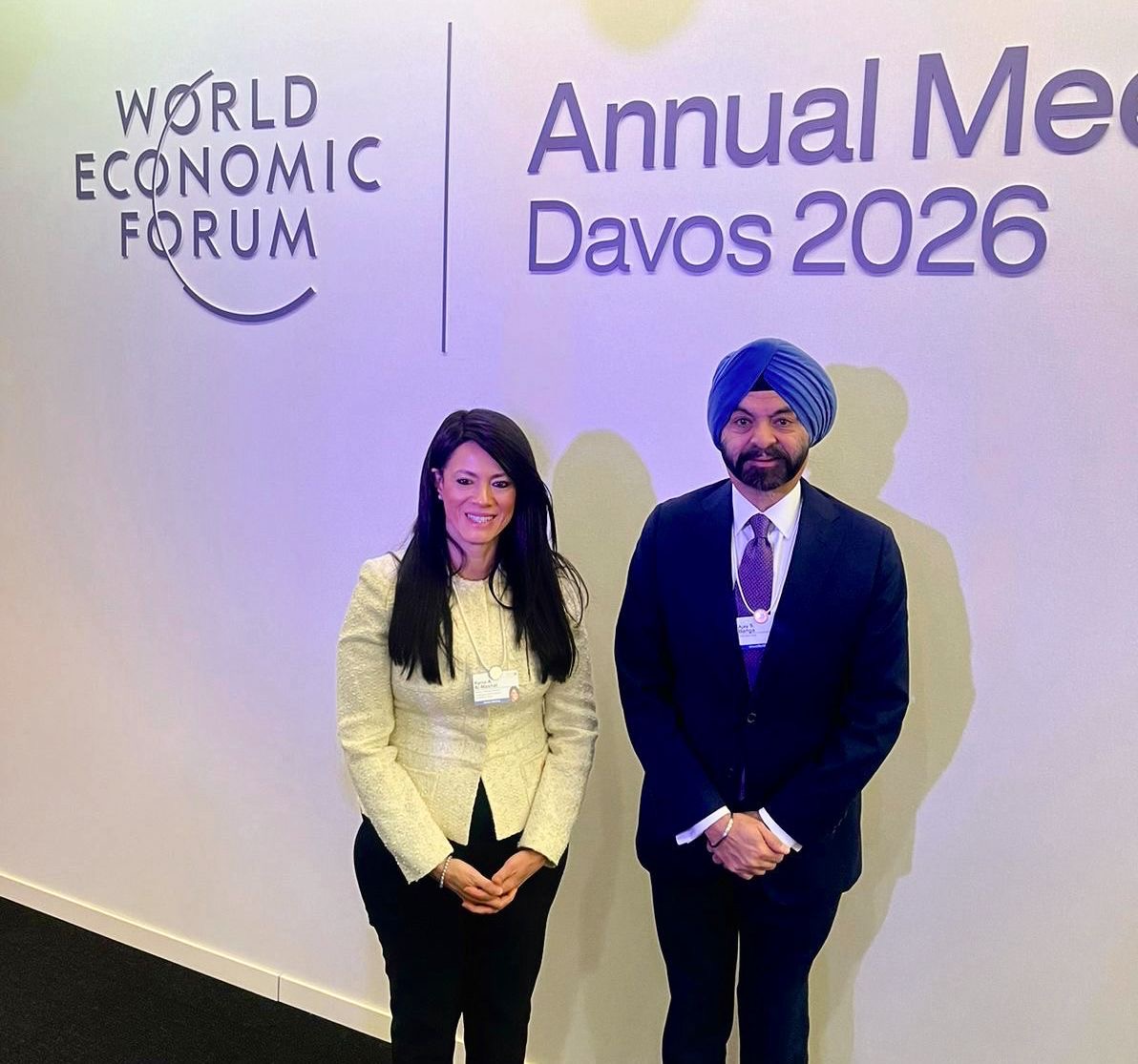
H.E. Dr. Rania Al-Mashat, Minister of Planning, Economic Development and International Cooperation and Egypt’s Governor at the World Bank, met with Ajay Banga, President of the World Bank Group, during her participation in the World Economic Forum in Davos. The two sides discussed ways to strengthen the strategic partnership in light of accelerating global challenges and the ongoing transformations in the landscape of international cooperation and development finance.
H.E. Dr. Al-Mashat emphasized that the messages delivered by H.E. President Abdel Fattah El-Sisi during his participation in Davos clearly reflected the scale of transformations and challenges facing the global economic system. These messages also highlighted the need to reshape pathways of international cooperation to ensure support for sustainable development and to maintain the momentum of international partnerships in the face of overlapping crises.
H.E. Dr. Al-Mashat stressed that multilateral development banks, primarily the World Bank Group, are required to play a more effective role in supporting developing countries by providing long-term development finance and expanding concessional and innovative financing instruments. This would enhance economic resilience and enable growth amid current geopolitical and economic conditions, while preserving the trajectory of international development partnerships.
H.E. Dr. Al-Mashat pointed out that the Egyptian economy is undergoing a structural transformation toward a model that relies more heavily on the real economy to generate resources and lead growth. She noted that the state continues to implement reforms aimed at boosting productivity, increasing the contribution of export-oriented sectors, and stimulating investment.
H.E. Dr. Al-Mashat added that human development, industrial localization, increased investments, and improving labor market efficiency constitute core pillars of Egypt’s Narrative for Comprehensive Development. The Narrative aims to achieve more sustainable and inclusive growth led by the private sector.
The Minister underscored that Egypt’s partnership with the World Bank Group has witnessed a qualitative shift in recent years, increasingly focusing on supporting policies and reforms that enhance private sector empowerment, improve the business environment, and raise the competitiveness of the national economy. This is achieved through the Bank’s role as a knowledge partner via various programs, including advisory services for the Government IPO Program, cooperation with the State-Owned Enterprises Unit, and other areas of collaboration.
H.E. Dr. Al-Mashat reaffirmed that the Egyptian economy continues to show steady improvement, with the private sector increasing its contribution to growth rates and total investment in parallel with ongoing structural reforms and an improving investment climate. She further stressed the importance of continuing cooperation with the World Bank Group in the coming period to mobilize additional investments, implement projects with broad development impact, and support Egypt’s sustainable development path, particularly through affiliated institutions such as the International Finance Corporation (IFC) and the Multilateral Investment Guarantee Agency (MIGA).