• Continued coordination to provide all forms of local and international support for the initiative and to expand the Shabab Balad Academy branches across various governorates
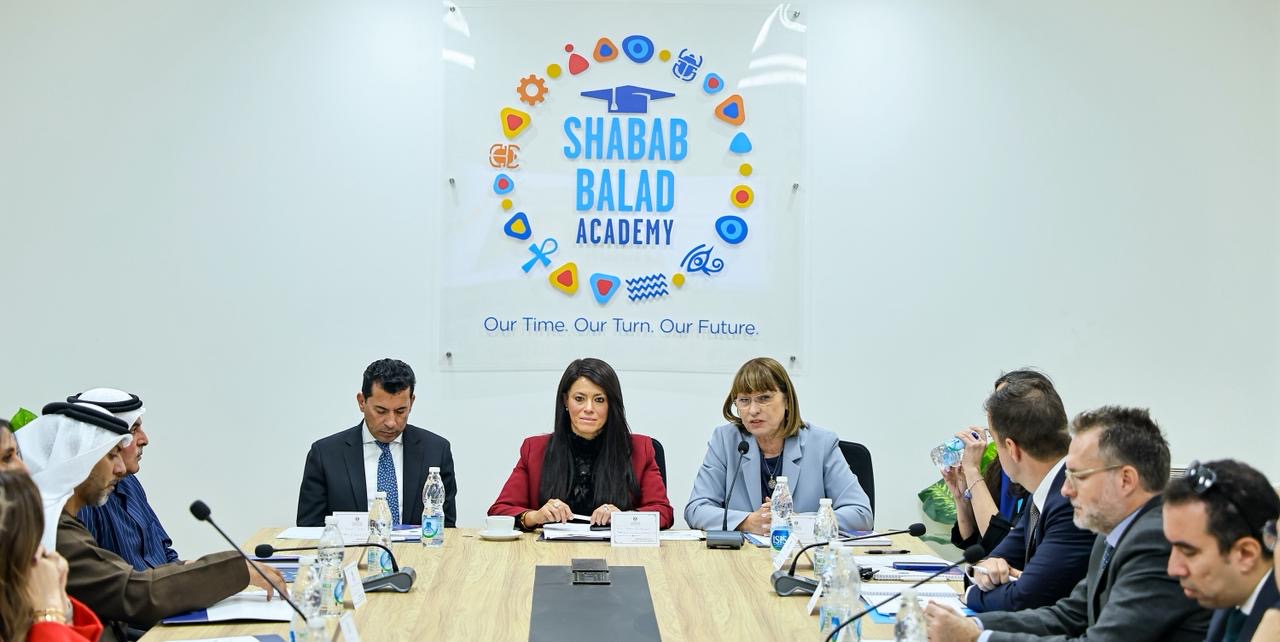
Following the inauguration of the headquarters of the “Shabab Balad” Academy at the Al-Gezira Youth Development Center, H.E. Dr. Rania Al-Mashat, Minister of Planning, Economic Development and International Cooperation, and Ms. Elena Panova, United Nations Resident Coordinator in Egypt, co-chaired the meeting of the Board of Directors of the “Shabab Balad” Initiative—the Egyptian national version of the United Nations Generation Unlimited initiative.
The meeting was attended by Dr. Ashraf Sobhy, Minister of Youth and Sports; Mr. Hamad Al Zaabi, Ambassador of the United Arab Emirates to Cairo; Mr. Ulric Shannon, Ambassador of Canada to Cairo; Mr. Abdulaziz Al Ghurair, Chairman of Al Ghurair Foundation; Dr. Kevin Frey, Chief Executive Officer of the global Generation Unlimited initiative; Mr. Eric Oechslin, Director of the International Labour Organization Office in Egypt; Ms. Reem Sami Saad, Board Member of Samcrete Investments; in addition to representatives of development partners and the private sector.
The meeting discussed the strategy of the Shabab Balad Initiative and implementation priorities for the coming phase, aiming to empower approximately 13 million young men and women nationwide by 2027. This will be guided by the international strategy of Generation Unlimited for the period 2026–2029. Discussions followed the inauguration of the Academy’s headquarters and focused on programs to empower youth and young women and enable them to access decent employment opportunities through diverse pathways, including education, employment, entrepreneurship, training, skills development, and digital transformation.
The meeting also addressed the importance of participation by non-profit institutions in supporting youth, particularly in light of Al Ghurair Foundation’s contribution to supporting the Shabab Balad Initiative, expanding its physical and digital infrastructure, and establishing new Shabab Balad Academy branches across the governorates.
At the outset of the meeting, H.E. Dr. Rania Al-Mashat stated that this meeting marks the first board meeting following the inauguration of the Shabab Balad Academy, which represents a significant and tangible milestone in the journey of the national initiative that has received the attention of H.E. President Abdel Fattah El-Sisi since its launch at the World Youth Forum in 2022 in Sharm El-Sheikh. She emphasized that the initiative reflects the strength of partnerships, coordination, and joint action between the government, UN organizations, the private sector, and development partners, and that it has become one of the key initiatives targeting the empowerment of Egyptian youth by developing their skills and capabilities and preparing them for the labor market through continuous alignment with evolving needs.
She extended her appreciation to the United Nations, the Ministry of Youth and Sports, and all partners for their full support of the initiative during the recent period, stating:
“We will work diligently in the coming phase, through the strategic framework of the partnership between Egypt and the United Nations, as well as the strategic frameworks of Egypt’s development partnerships with bilateral and multilateral partners, to mobilize all necessary resources and financing—both domestically and internationally—to enable the initiative to continue fulfilling its role. We will also leverage my membership in the Global Leadership Council of the initiative to enhance South–South cooperation and exchange expertise with other countries.”
During the meeting, Dr. Ashraf Sobhy, Minister of Youth and Sports, reaffirmed the Egyptian state’s commitment to the national voluntary pledge announced during the high-level regional meeting on “Learning to Earning” in Amman in 2022, which aims to empower more than 13 million young men and women by 2027 through education, training, skills development, linkage to employment and entrepreneurship opportunities, enhanced digital access, and positive civic engagement. He noted that Egypt has so far reached more than 6.4 million young people under the Learning to Earning agenda, reflecting tangible progress in implementing this national commitment.
The Minister also stressed the importance of governance and institutional sustainability, noting that the Shabab Balad Academy—serving as the executive arm and one of the leading platforms of the national Shabab Balad Initiative—is currently being institutionalized and registered as a youth entity in accordance with the Law on the Regulation of Youth Entities. This step aims to ensure sustainability, national ownership, enhanced transparency, and nationwide expansion of its programs in alignment with Egypt’s priorities and Egypt Vision 2030.
For her part, Ms. Elena Panova affirmed that the launch of the Shabab Balad Academy represents a highly significant milestone and will serve as a catalyst for numerous developments in the coming period across multiple pathways related to youth education and employment. She highlighted the United Nations’ important role in supporting the initiative and expressed her aspiration to continue joint efforts to empower youth and girls in Egypt.
Mr. Abdulaziz Al Ghurair, Chairman of Al Ghurair Foundation, emphasized his commitment to supporting and empowering youth across the region, noting that the Foundation is providing all forms of support to advance the objectives of the Shabab Balad Initiative. He stressed the importance of closely monitoring agreed targets through key performance indicators to ensure the achievement of desired outcomes that directly benefit Egyptian youth.
Ms. Natalia Winder Rossi, Representative of UNICEF in Egypt, reviewed the achievements realized through the initiative to date and its future directions, aiming to empower youth aged 10–24. These targets include reaching 5 million young people in education, enabling 5 million young people to participate in training and capacity-building programs, supporting 1 million young people in accessing decent employment opportunities, and enhancing communication and digital transformation skills for 3 million young men and women.