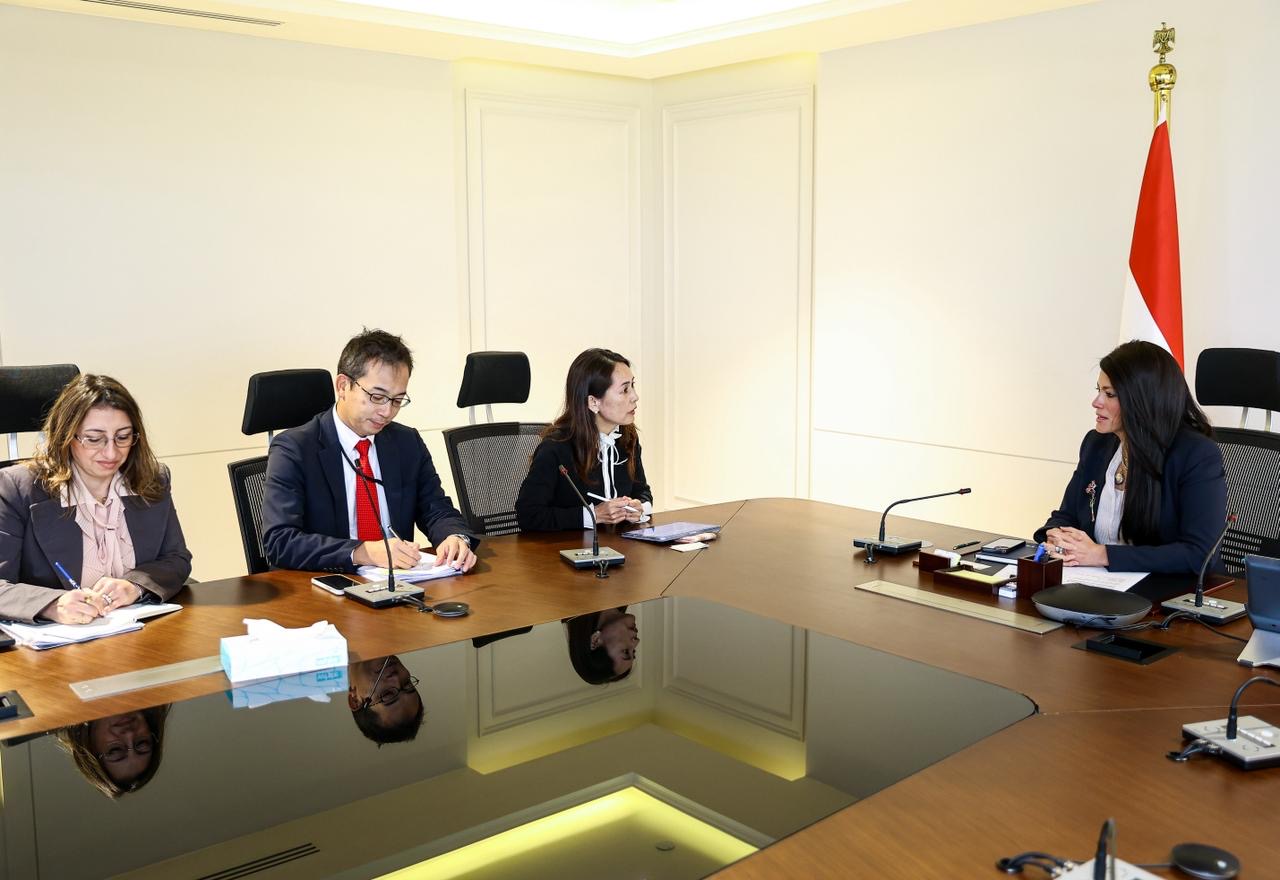
● Al-Mashat discusses sectoral priorities for investment projects in the framework of cooperation with JICA and increasing financing for the private sector.
● Expanding cooperation in vocational education, technology schools, and human capital investment.
Dr. Rania Al-Mashat, Minister of Planning, Economic Development, and International Cooperation, received Ms. Yuko Mitsui, First Vice President of the Japan International Cooperation Agency (JICA), to discuss ways to enhance future cooperation within the framework of the long-term strategic partnership between the Arab Republic of Egypt and Japan, which has contributed for decades to strengthening development, economic, and cultural cooperation between the two countries.
At the beginning of the meeting, Dr. Al-Mashat congratulated Ms. Mitsui on her appointment as First Vice President of JICA in October 2025, wishing her a successful and fruitful tenure during which she would achieve further accomplishments in support of Egypt–Japan cooperation.
She noted that Egypt recently launched its “Narrative for Economic Development: Reforms for Growth, Jobs & Resilience”, which integrates Vision 2030, the government’s program, and sectoral strategies to promote the transformation of the Egyptian economy toward productive sectors, emphasizing that the government continues to implement economic and structural reforms that enhance Egypt’s competitiveness.
Al-Mashat also expressed Egypt’s appreciation for JICA and the Government of Japan for their pivotal role in supporting, financing, and implementing the Grand Egyptian Museum project—one of the region’s most significant cultural projects. The museum is the largest in the world dedicated to a single civilization and one of the largest development aid projects in cultural heritage in Africa and the Middle East, serving as a global model for preserving culture and history.
She highlighted the establishment of the restoration center at the Grand Egyptian Museum in cooperation with JICA, which now serves as a regional center of excellence for cultural heritage preservation, combining extensive Egyptian expertise with Japanese innovation in restoration and conservation.
Dr. Al-Mashat also underscored the long-standing partnership with JICA, noting that over the past seventy years, Egypt–Japan relations have seen diverse cooperation aligned with Egypt’s development priorities, resulting in a technical and development aid portfolio of $2.4 billion in grants, alongside concessional financing for various projects.
She referenced the joint report released during the 9th Tokyo International Conference on African Development (TICAD 9), which highlights seventy years of fruitful development cooperation with JICA and presents the achievements and joint projects over this period.
Al-Mashat expressed Egypt’s deep appreciation for Japan’s humanitarian support to the Palestinian people in Gaza, including recent contributions to basic relief efforts and urgent humanitarian needs, emphasizing Egypt’s continued role in facilitating the delivery of humanitarian aid to Gaza and ensuring the regular supply of food, medical, and logistical support.
During the meeting, both sides discussed pioneering projects between Egypt and Japan. The partnership in education is a cornerstone of efforts to modernize and develop Egypt’s education system, integrating Japanese educational activities and methodologies into Egyptian schools, and adopting the Japanese vocational education model in some technical institutes to develop students’ technical and vocational skills.
The meeting also covered future cooperation in developing intelligent transport networks and the metro system, as well as JICA’s role in providing concessional financing to the private sector to support projects under the NWFE country platform.
Other areas of potential future collaboration discussed included human capital development, private-sector support, regional connectivity and infrastructure, healthcare facilities, digital transformation, and cultural heritage preservation. The Egyptian government, in cooperation with Japan, aims to leverage the significant potential of artificial intelligence to build a robust, future-ready system, contributing to comprehensive and sustainable development in Egypt.