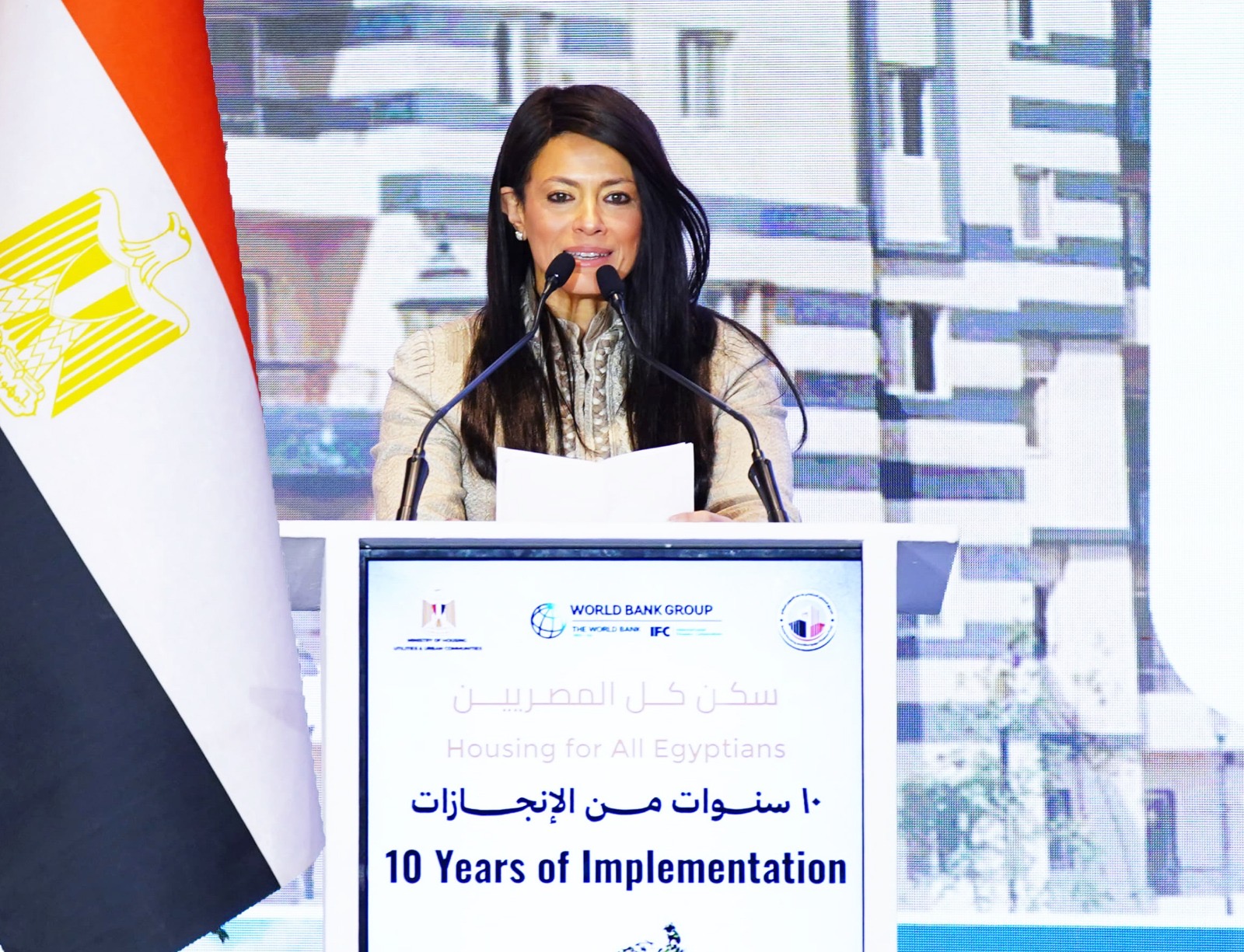
H.E. Dr. Rania Al-Mashat: “Housing for All Egyptians” is among the most prominent national projects launched and championed by President Abdel Fattah El-Sisi for its direct positive impact on citizens
• The program represents a model for integrating economic and social policies, strengthening social justice, and improving quality of life.
• More than EGP 200 billion in public investments between 2014 and 2025, in addition to EGP 47 billion in World Bank financing.
• Egypt’s Narrative for Comprehensive Development: Reforms for Growth, Jobs & Resilience aims to achieve balanced regional and local development and leverage the comparative advantages of governorates
H.E. Dr. Rania Al-Mashat, Minister of Planning, Economic Development and International Cooperation, participated in the celebration marking “Housing for All Egyptians: 10 Years of Achievement,” held today in the presence of H.E. Dr. Mostafa Madbouly, Prime Minister; H.E. Lt. Gen. Kamel El-Wazir, Deputy Prime Minister for Industrial Development and Minister of Industry and Transport; a number of current and former ministers; Ms. Mai Abdel Hamid, CEO of the Social Housing and Mortgage Finance Fund; Cheick-Oumar Sylla, IFC Regional Director for North Africa; and Mr. Mr. Stephane Guimbert, World Bank Country Director for Egypt.
In her remarks, H.E. Dr. Al-Mashat stated that the event commemorates ten years since the launch of the comprehensive social housing finance program, which stands as one of the most prominent and impactful national projects initiated by President Abdel Fattah El-Sisi, based on his conviction that citizens are both the core and ultimate objective of development.
She added that the “Housing for All Egyptians” program is among the key initiatives reflecting the integration of economic and social policies. It is considered one of Egypt’s most important social protection programs, serving as a cornerstone for advancing social justice and improving quality of life by meeting the demand for adequate housing for more than four million citizens across all governorates—particularly low- and middle-income groups—thereby strengthening social cohesion and supporting comprehensive economic development.
H.E. Dr. Al-Mashat emphasized that the program represents an unprecedented initiative, built on sustained national efforts and international partnerships over more than a decade. The State allocated over EGP 200 billion in public investments between 2014 and 2025 to implement the project, in addition to concessional financing from the World Bank, the world’s largest multilateral development bank, amounting to USD 1 billion, equivalent to EGP 47 billion at current exchange rates. She noted that the program is the largest of its kind globally, underscoring the strength of Egypt’s development model based on national ownership and effective collaboration with international partners.
She further explained that the program expanded access to decent and affordable housing for low-income families through five core components: strengthening the institutional capacity of the Social Housing and Mortgage Finance Fund; enhancing the effectiveness of social housing programs; improving access to homeownership and rental units; reducing geographic mismatches in housing provision; and absorbing vacant and unfinished housing units.
H.E. Dr. Al-Mashat highlighted that the program’s success extended beyond the real estate sector and housing supply to include a significant increase in financial inclusion and a major transformation in the mortgage finance market. This progress was reflected in the growth of the mortgage finance market to approximately EGP 95 billion by the end of November 2025.
She stressed that the Egyptian State is committed to achieving balanced regional and local development, grounded in the belief that spatial and social justice are fundamental pillars of comprehensive development and improved quality of life across all governorates. Accordingly, the axis of “spatial planning for the localization of economic development” was established as a core pillar of Egypt’s Narrative for Comprehensive Development: Reforms for Growth, Jobs & Resilience, the second edition of which was recently finalized in cooperation with various ministries and national entities. She noted that the coming years aim to usher in a new phase where spatial considerations become central to economic development through a more effective planning system, clearer institutional roles, and stronger private sector partnerships, placing governorates at the heart of the development process.
She added that the government is adopting an integrated institutional approach to modernize national and local planning systems to enhance flexibility and effectiveness. This includes the use of development gap indicators, ensuring fairer resource allocation through an updated financing formula, and improving spending efficiency.
H.E. Dr. Al-Mashat noted that this model is based on strategic directions starting with updating governorate investment maps to reflect their competitive advantages, strengthening vertical integration between central, regional, and local planning, and linking investment, urban, and financing plans within a unified framework that integrates medium-term and annual governorate plans with national visions.
She revealed that the Ministry of Planning, Economic Development and International Cooperation has undertaken several steps to enhance planning processes and improve investment allocation efficiency. These include updating criteria for evaluating investment projects to ensure alignment with each governorate’s development priorities, as well as adopting a new financing formula to allocate resources more equitably based on development indicators.
H.E. Dr. Al-Mashat concluded her remarks by stating:
“Today, we are not merely reviewing figures or achievements; rather, we are witnessing a living embodiment of a State vision that places citizens at the center of development, and positions adequate housing as a foundation for building capable individuals, cohesive communities, and a more just and sustainable economy.”
She expressed her appreciation to the political leadership for its unwavering belief in and commitment to implementing these projects, extended her thanks to Prime Minister Dr. Mostafa Madbouly for his continuous support and close follow-up, and commended the World Bank for its enduring partnership, which consistently delivers impactful projects benefiting citizens across Egypt.