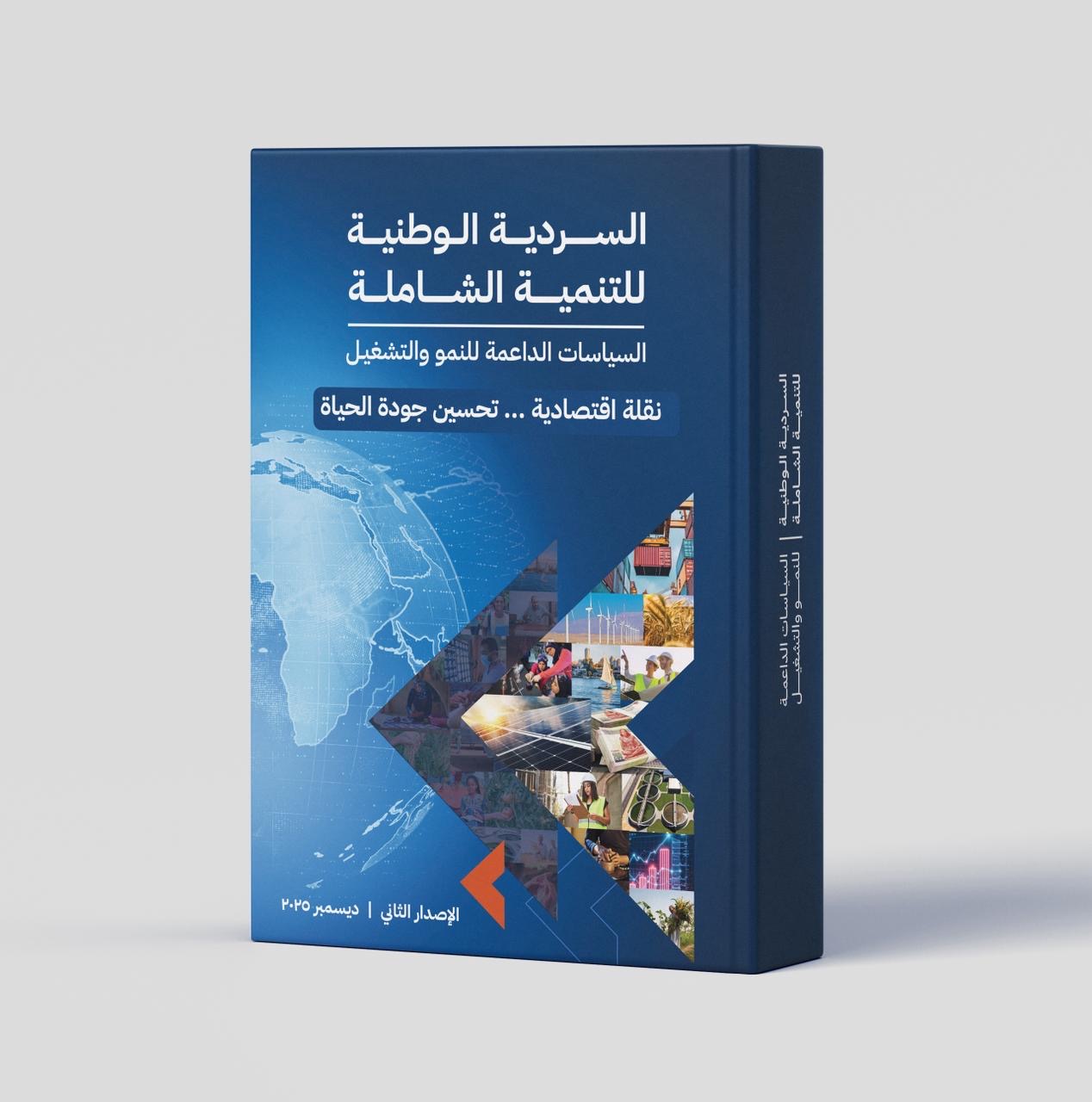
H.E. Dr. Rania Al-Mashat, Minister of Planning, Economic Development, and International Cooperation, announced the public release of the second edition of “Egypt’s Narrative for Comprehensive Development: Reforms for Growth, Jobs & Resilience” on the Ministry’s official website, following its completion in line with the timeline announced on September 7.
“Egypt’s Narrative for Comprehensive Development: Reforms for Growth, Jobs & Resilience” serves as Egypt’s overarching framework for comprehensive development, ensuring alignment and integration between Egypt Vision 2030 and updated sectoral strategies, in light of ongoing regional and global developments. The Narrative aims to support Egypt’s transition toward a more diversified economic model based on maximizing the use of human capital, improving quality of life, and prioritizing higher value-added and export-oriented (tradable) sectors. This transformation builds on the country’s advanced infrastructure achievements and includes a redefined role for the state to enhance competitiveness and stimulate private sector participation, thereby completing the path of economic reform and consolidating macroeconomic stability.
The Narrative includes an executive summary followed by 16 core pillars, covering human development; macroeconomic stability, including fiscal sustainability through fiscal and monetary policies, governance of public investments, and financing for development; promotion of domestic and foreign investment, including the role of the Suez Canal Authority; enhancing the attractiveness of the non-bank financial market; investment incentives in real estate; development of the foreign trade system; support for industrial development; and improving labor market efficiency and flexibility.
These pillars place particular emphasis on priority sectors, notably industry, tourism, agriculture, and information and communications technology, in addition to energy and water resources, which serve as enabling sectors that support expansion and growth. The Narrative also addresses spatial planning for the localization of economic development, the green transition, and strengthening international cooperation and partnerships—including development-oriented foreign policy—ensuring more productive, inclusive, and sustainable economic growth.
Each pillar concludes with a package of policies supporting growth and employment within the framework of the National Structural Reform Program, translated into quantitative targets and a simplified macroeconomic framework with measurable objectives through 2030. The Narrative concludes with an action plan for Egypt’s Narrative for Comprehensive Development, which translates targets into a clear implementation plan linking development performance to financial performance within the medium-term budget framework, in accordance with the program- and performance-based budgeting methodology, to ensure spending efficiency and effective implementation.
The full, updated Narrative is available at the following link:
https://mped.gov.eg/NationalNarrative
Human Development
This pillar presents an integrated vision of the Egyptian state’s approach to intensifying human development efforts as the primary driver of high-quality, more equitable, and sustainable economic growth. It is grounded in the principle that citizens are both the objective and the engine of development, and that economic growth derives its value from its impact on improving citizens’ quality of life.
Macroeconomic Stability
Recognizing the importance of macroeconomic stability as a cornerstone of comprehensive and sustainable development, this pillar presents a comprehensive vision of the strategic framework and policies aimed at promoting sustainable economic growth and increasing the role of the private sector as a key driver of development. It also enhances Egypt’s ability to overcome the “middle-income trap.” The pillar reviews the economic reform path since March 2024, outlining fiscal policy pillars under the medium-term fiscal strategy, the monetary policy framework based on a flexible exchange rate regime and inflation targeting, alignment of the state investment plan with the medium-term budget, and ensuring policy coherence in implementing the National Structural Reform Program.
Industrial Development
This pillar outlines the strategic framework for industrial development as a key pillar of sustainable economic growth, competitiveness, and job creation. It reviews the National Industry Strategy 2030 and the emergency plan for industrial advancement with its seven pillars, while identifying 28 priority promising industries based on clear selection criteria reflecting the state’s focus on deepening local manufacturing and maximizing value added.
Investment
This pillar reviews the strategic, legislative, and institutional framework governing investment in Egypt, including international commitments and bilateral investment agreements. It focuses on improving the business environment and attracting domestic and foreign investment in line with Egypt Vision 2030 and the government’s program of work. It also addresses the National Strategy for Foreign Direct Investment (2025–2030), including the methodology for identifying target sectors such as renewable energy, industry, and technology, as well as the integration of investment and foreign trade policies and promotion tools such as the investment map.
Suez Canal Economic Zone
This pillar reviews the Suez Canal Economic Zone (SCZone), highlighting its strategic location along one of the world’s most important trade corridors, its advanced infrastructure, attractive customs and tax incentives, and the digital one-stop-shop system that facilitates procedures and accelerates business operations. It also highlights promising investment opportunities in strategic sectors, including green hydrogen, batteries, textiles, pharmaceuticals, food industries, and engineering industries.
Non-Bank Financial Sector
To complete the comprehensive picture of enhancing the business and investment environment, this pillar focuses on the Financial Regulatory Authority’s efforts to increase the attractiveness of investment in the non-bank financial sector through a comprehensive reform program. These efforts include legislative development, deepening financial markets, and strengthening digital transformation and governance to create a safer, more transparent investment environment with diversified financial instruments and higher liquidity. Reforms also include developing the insurance sector and improving regulatory efficiency to attract domestic and foreign investment and achieve sustainable growth.
Real Estate Investment
This pillar addresses the investment vision for the housing, utilities, and urban development sector, aimed at fostering a competitive and sustainable investment environment that attracts domestic and foreign capital, maximizes economic returns, and improves quality of life. This is achieved through expanding investment opportunities in integrated urban development projects for fourth-generation cities, supported by incentive and facilitation policies, promoting sustainable financing tools such as real estate funds and fractional ownership, digital transformation, and activating financing instruments to strengthen strategic partnerships.
Foreign Trade
This pillar reviews global, regional, and Egyptian foreign trade trends and presents the strategic and legislative framework for enhancing Egypt’s competitiveness in international markets. It outlines the foundations of Egypt’s Trade Policy Document, which defines sectoral priorities and practical mechanisms to stimulate and diversify exports and facilitate access of Egyptian products to global markets, thereby strengthening national economic competitiveness.
Sectoral Outlook
A dedicated pillar focuses on sectoral outlooks, emphasizing high value-added, tradable sectors such as tourism, agriculture, and information and communications technology as key growth drivers, alongside energy and water resources as enabling sectors. The pillar presents supporting sectoral strategies and policies, highlighting how employment multipliers are used to prioritize interventions and policies that support structural transformation, competitiveness, and sustainable growth based on decent job creation.
Green Transition
This pillar reviews national frameworks and strategies supporting the green transition, including the National Climate Change Strategy 2050, nationally determined contributions (NDCs), and various sectoral strategies. It also addresses climate governance, regulatory frameworks, and mechanisms for integrating environmental considerations into development planning, with particular emphasis on the role of the private sector and green investments in financing climate action.
Labor Market Efficiency and Resilience
This pillar analyzes Egypt’s labor market in local and global contexts, reviewing growth and productivity patterns, employment characteristics in the private and informal sectors, and the legislative and strategic framework governing the labor market. It highlights key strategies to enhance labor market efficiency and flexibility, including the National Employment Strategy, higher education and scientific research, and technical education as core drivers of growth, productivity, and decent job creation, particularly for youth and women.
Spatial Planning for the Localization of Economic Development
This pillar addresses spatial planning efforts to localize economic development through implementation of the State Public Planning Law at national, sectoral, regional, and local levels, ensuring integration with the Unified Building Law, the Unified Public Finance Law, and the forthcoming local administration framework. It highlights the concept of effective localization, based on integrated local programs, citizen plans, and community participation mechanisms.
International Cooperation and Partnerships
This pillar focuses on innovative financing mechanisms such as debt swaps and guarantees to stimulate growth and financial stability, in addition to public-private partnerships. It highlights concessional development financing to empower the private sector and entrepreneurship as a tool for attracting foreign investment and creating jobs. The pillar also emphasizes South-South and triangular cooperation, including strategies to strengthen cooperation with Africa and BRICS countries, as well as economic cooperation with bilateral development partners through joint committees, and the role of regional financial and guarantee institutions in supporting trade and industrial activities.
National Structural Reform Program
This section reviews priority economic, financial, sectoral, and social reforms that have been implemented, as well as ongoing and planned reforms under the program, which translates into more than 400 policies and measures implemented by approximately 50 government and national entities. The core of Egypt’s Narrative for Comprehensive Development is based on a clear complementary relationship between macroeconomic stability and structural reforms: stability enables reform, and reform reinforces stability, thereby strengthening the foundations of economic development and unlocking the Egyptian economy’s full potential.
Quantitative Targets
This section translates structural reform priorities and proposed solutions into a coherent set of quantitative targets within a simplified macroeconomic framework, including measurable objectives through 2030 and aspirational targets through 2050. The framework is based on three main scenarios: a baseline scenario reflecting the expected trajectory under current reform efforts; an accelerated reform scenario based on faster reform implementation; and a conservative scenario that accounts for risks stemming from rapidly evolving regional and global developments.
Action Plan for Egypt’s Narrative for Comprehensive Development
This section presents the action plan as the practical framework for translating the Narrative into a clear implementation plan. The Narrative’s objectives are translated into nine strategic priorities that guide the design of the action plan, falling under two main outcomes: achieving high and sustainable economic growth, and ensuring fair distribution of its returns. The section explains how these priorities are linked to development and financial performance, enabling measurement of the real impact of public spending through quantitative performance indicators within a defined timeframe.