• Implementation of 17 solar power stations under the SAIL Project to provide clean energy for 3,528 feddans in Aswan
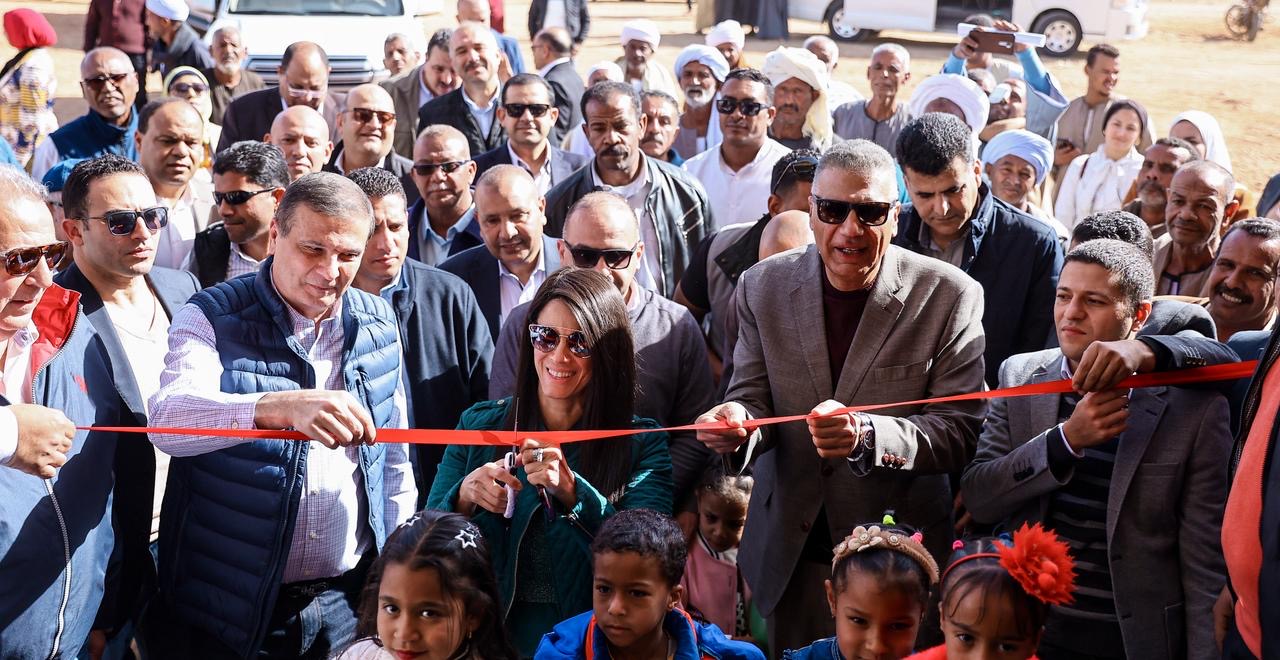
H.E. Dr. Rania Al-Mashat, Minister of Planning, Economic Development and International Cooperation, and Mr. Alaa Farouk, Minister of Agriculture and Land Reclamation, accompanied by Major General Ismail Kamal, Governor of Aswan, and Dr. Mohamed Abdel Qader, IFAD Country Director for Egypt, inspected and inaugurated the Al-Zahraa Solar Power Station serving collective irrigation units in Al-Shahama Village. The delegation also visited a secondary school as part of an inspection tour of Aswan Governorate, which included reviewing several development projects and activities under the Sustainable Agricultural Investments and Livelihoods (SAIL) project.
The Al-Zahraa Solar Power Station serves 480 feddans and is one of 17 solar power stations implemented in the Wadi Al-Sa‘ayda area. These include Wadi Al-Nil Station, Al-Ashraf 1 Station, Al-Ashraf 2 Station, Al-Nidal Stations, and Al-Shahama / Al-Mostaqbal / Al-Ashraf stations (12 stations). Collectively, the 17 stations serve a total of 3,528 feddans.
In a related context, the delegation witnessed the handover of eight modern agricultural machines to a number of smallholder farmers in the area as in-kind support to enhance their productive capacities. The ministers engaged directly with farmers and encouraged them to expand the use of modern agricultural technologies, stressing that empowering smallholder farmers is a top state priority. This is achieved by providing the necessary tools to reduce post-harvest losses and improve crop quality, thereby generating higher economic returns for rural households in Haya Karima villages and land reclamation areas.
The delegation also visited a secondary school in Al-Shahama Village in the Wadi Al-Sa‘ayda area, implemented under the SAIL Project.
H.E. Dr. Rania Al-Mashat stated that expanding the use of solar energy units to operate collective irrigation systems reflects the State’s orientation toward supporting smallholder farmers and easing production burdens by reducing reliance on high-cost conventional energy sources. This contributes to stabilizing agricultural activities and improving irrigation efficiency, particularly in rural areas of Upper Egypt.
She added that reliance on solar energy to operate collective irrigation units supports the transition from flood irrigation to modern irrigation systems, leading to rationalized water consumption and reduced electricity and diesel costs. This, in turn, increases productivity and improves farmers’ incomes. She emphasized that these projects enhance both environmental and economic sustainability and support the State’s efforts to improve living standards in agricultural communities by providing practical and sustainable solutions for irrigation and energy needs.
H.E. further underscored that providing educational opportunities within villages and surrounding areas reduces both time and financial burdens on families and limits the hardship associated with long-distance travel for students. She noted that the SAIL Project has constructed 10 basic and secondary education schools in its areas of operation, positively impacting school retention rates and improving quality of life in rural communities. She affirmed that these educational projects form part of an integrated development approach that supports human development alongside infrastructure and agricultural production projects in Upper Egypt.
During the visit, H.E. Dr. Al-Mashat emphasized that providing educational services in newly reclaimed areas is a key factor in the success of settlement and community stability efforts. She noted that establishing secondary schools in these areas helps meet the essential needs of beneficiary families and encourages permanent settlement, supporting the State’s plans for balanced urban expansion and easing population pressure on the Delta region.
For his part, Mr. Alaa Farouk, Minister of Agriculture and Land Reclamation, stated that the Sustainable Agricultural Investments (SAIL) Project represents a cornerstone for achieving food security in the most vulnerable areas by building integrated agricultural development communities and contributing to improved incomes for beneficiaries. He highlighted that the project adopts an integrated package that includes the introduction of modern irrigation systems for water conservation, the use of advanced technologies and solar energy, and capacity-building for farmers to adapt to climate change, while ensuring the sustainability of productivity and creating resilient farming environments capable of addressing challenges.
The Minister also praised the strategic partnership with the International Fund for Agricultural Development (IFAD), describing it as a successful model of impactful cooperation that directly improves the lives of smallholder farmers. He noted the ongoing coordination to maximize the benefits of international financing for innovative and sustainable projects that serve rural development, empower rural women, and support smallholder farmers, in line with Egypt’s Vision 2030, while enhancing agricultural and social services and achieving comprehensive rural development.
Minister Farouk further stressed the full commitment to delivering fertilizer allocations to farmers in full and without any reduction, confirming that fertilizer distribution will continue regularly for all crops, including sugarcane and mangoes, even in cases where outstanding installments exist. This measure aims to support farmers and ensure the productivity of strategic crops.
He also directed the provision of specialized excavators to accelerate the excavation of irrigation water storage basins serving villages in the area, ensuring water availability and the stability of irrigation operations throughout the year, and addressing challenges faced by farmers at the tail ends of canals or in elevated areas.