• Ministers direct the assessment and removal of all challenges facing smallholder farmers in the targeted villages
• H.E. Dr. Rania Al-Mashat: The State is implementing integrated development interventions across governorates to improve citizens’ economic and social conditions
• Integration between international partnerships and the State’s investment plan to localize development in rural and remote areas
• Minister of Agriculture: The State is keen to transform Upper Egypt into an investment-attractive and food-producing region; Wadi Al-Sa‘ayda villages embody Egypt’s integrated rural development efforts
• Minister of Agriculture reassures farmers: “We are with you in the field, and our teams are working around the clock”
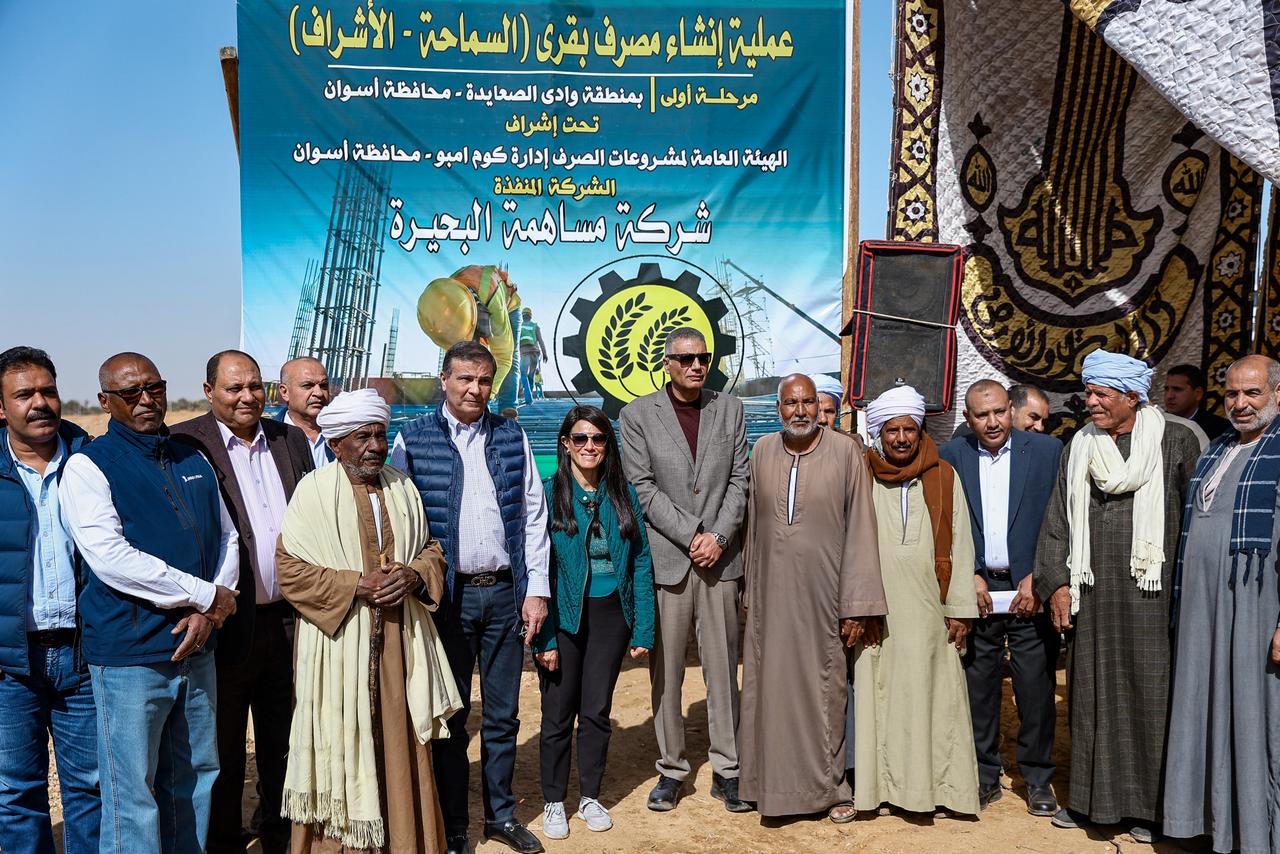
H.E. Dr. Rania Al-Mashat, Minister of Planning, Economic Development and International Cooperation, and Mr. Alaa Farouk, Minister of Agriculture and Land Reclamation, accompanied by Major General Ismail Kamal, Governor of Aswan, and Dr. Mohamed Abdel Qader, IFAD Country Director for Egypt, inspected a number of development projects during their field visit to Aswan Governorate. The visit included reviewing activities of the Sustainable Agricultural Investments and Livelihoods (SAIL) project.
The projects inspected in the Wadi Al-Sa‘ayda area included agricultural drainage works in Al-Ashraf and Al-Samaha villages in Upper Egypt. These works represent a key pillar for improving quality of life in rural communities, given their direct role in addressing drainage water challenges that negatively affect agricultural production and sustainability. The implementation of agricultural drainage systems contributes to restoring the productive capacity of agricultural land and promoting the optimal use of natural resources, which is positively reflected in agricultural stability and increased economic returns for farmers.
The delegation also inspected internal irrigation canals in Wadi Al-Sa‘ayda, which constitute a fundamental component of rationalizing water use and maximizing efficiency—particularly in areas suffering from irrigation water shortages at canal tail ends. These interventions contribute to equitable water distribution and improved delivery efficiency to agricultural lands, directly enhancing agricultural stability and increasing the productivity of small landholdings.
Rehabilitation works for irrigation canals implemented under the SAIL Project contribute to reducing water losses caused by leakage, lowering operation and maintenance costs, improving soil characteristics, and increasing crop productivity—thereby supporting farmers’ incomes and improving living standards in rural communities.
The two ministers were keen to listen directly to farmers and beneficiary women regarding challenges related to water seepage into homes and the completion of irrigation projects. They directed the swift completion of ongoing projects and the removal of all obstacles facing beneficiaries.
H.E. Dr. Rania Al-Mashat explained that these projects contribute to improving beneficiaries’ living standards by expanding cultivable areas and enhancing productivity, which supports job creation in local communities and increases rural household incomes. She emphasized that the State attaches special importance to integrated development projects that combine economic and social dimensions and support sustainable agricultural development efforts—particularly in Upper Egypt—thereby achieving comprehensive development goals and strengthening citizens’ ability to improve their livelihoods.
She also stressed the importance of national ownership of projects implemented through international partnerships, alongside the vital role of government in ensuring their success and providing all necessary facilitation. She highlighted the integration between international partnerships and the State’s investment plan to maximize development impact and ensure optimal benefits for citizens.
For his part, Mr. Alaa Farouk, Minister of Agriculture and Land Reclamation, affirmed that Egypt is moving forward with the implementation of a comprehensive vision for the development of Upper Egypt, in line with the directives of President Abdel Fattah El-Sisi, to transform it into an investment-attractive and food-producing region. He noted that the efforts implemented in the villages of Wadi Al-Sa‘ayda reflect the State’s commitment to injecting substantial investments to develop agricultural infrastructure in Upper Egypt and achieve integrated rural development that raises living standards and provides sustainable employment opportunities for youth and rural women.
The Minister highlighted the Ministry’s ongoing efforts to rehabilitate and clear irrigation canals and drains, which top its executive priorities in support of Egyptian farmers, enhancing water-use efficiency, ensuring effective water delivery to canal tail ends, and sustaining agricultural production—thereby increasing the productivity of strategic crops. He added that, in cooperation with agricultural directorates and the Land Improvement Authority, thousands of kilometers of private canals have been cleared, resulting in reduced irrigation costs and water losses. He stressed that canal rehabilitation works are being synchronized with the transition to modern irrigation systems, with continued coordination with the Ministry of Water Resources and Irrigation to create an integrated irrigation system serving Egypt’s food security objectives.
Minister Farouk delivered a message of reassurance to farmers, stating: “We are with you in the field, and our field teams are working around the clock to remove any obstacles you face. We will not tolerate any negligence that affects farmers’ rights.”
In a related context, the delegation visited Al-Samaha Village and reviewed a number of grants delivered to women beneficiaries. During the visit, H.E. Dr. Al-Mashat affirmed that Al-Samaha Village represents an important model of integrated development interventions targeting the most vulnerable groups, particularly women breadwinners. She noted that grants provided to rural women reflect the State’s commitment to women’s economic and social empowerment and to creating a supportive environment that enables them to improve their living conditions, enhance self-reliance, and actively participate in local economic activity.
She added that projects implemented in the village—foremost among them support for educational and community services, in addition to the establishment of a women’s club—contribute to improving quality of life for women and their families. She further noted that, upon completion of the agricultural drainage system, groundwater level issues within the village will be addressed, leading to greater living stability and ease of movement within homes, particularly during winter. She emphasized that this integrated development approach enhances project sustainability and delivers direct, tangible impacts on the lives of citizens in rural areas.
H.E. Dr. Rania Al-Mashat also noted that, within the framework of the medium-term development plan and Egypt’s Narrative for Economic & Social Development: Reforms for Growth, Jobs & Resilience, the State is working to enhance the effectiveness of spatial planning and localize development across governorates. She highlighted the recent launch of the Narrative, which places particular emphasis on identifying each governorate’s comparative advantages, localizing economic development, and strengthening integration across sectors.
Mr. Alaa Farouk, Minister of Agriculture and Land Reclamation, reaffirmed that the State places special importance on empowering rural women as essential partners in success. He noted that the Ministry works through its projects to transform women into productive contributors by providing vocational training programs, facilitating concessional microfinance for micro-enterprises, and supporting handicrafts and home-based industries.
The Minister also directed the Executive Director of the SAIL Project to allocate a package of development initiatives for residents of Wadi Al-Sa‘ayda villages, in response to their needs. These initiatives include providing fully equipped poultry and rabbit production units to launch immediate production cycles, as well as supporting households with high-productivity buffalo heads (genetically improved breeds) to increase family income from milk and meat, alongside free veterinary support and technical follow-up to ensure sustainability.
Major General Ismail Kamal, Governor of Aswan, affirmed the Governorate’s strong commitment to supporting productive communities and empowering women breadwinners in line with political leadership directives, noting the continued coordination with relevant ministries and development partners to expand this successful model and maximize its positive outcomes.
Dr. Mohamed Abdel Qader, IFAD Country Director for Egypt, stated that the SAIL Project has become a leading experience in agricultural transformation in newly reclaimed lands and a model for achieving integrated rural development. He emphasized the importance of ensuring the sustainability of project activities and strengthening coordination and cooperation among state institutions and international organizations, in support of national efforts to achieve the Sustainable Development Goals (SDGs).