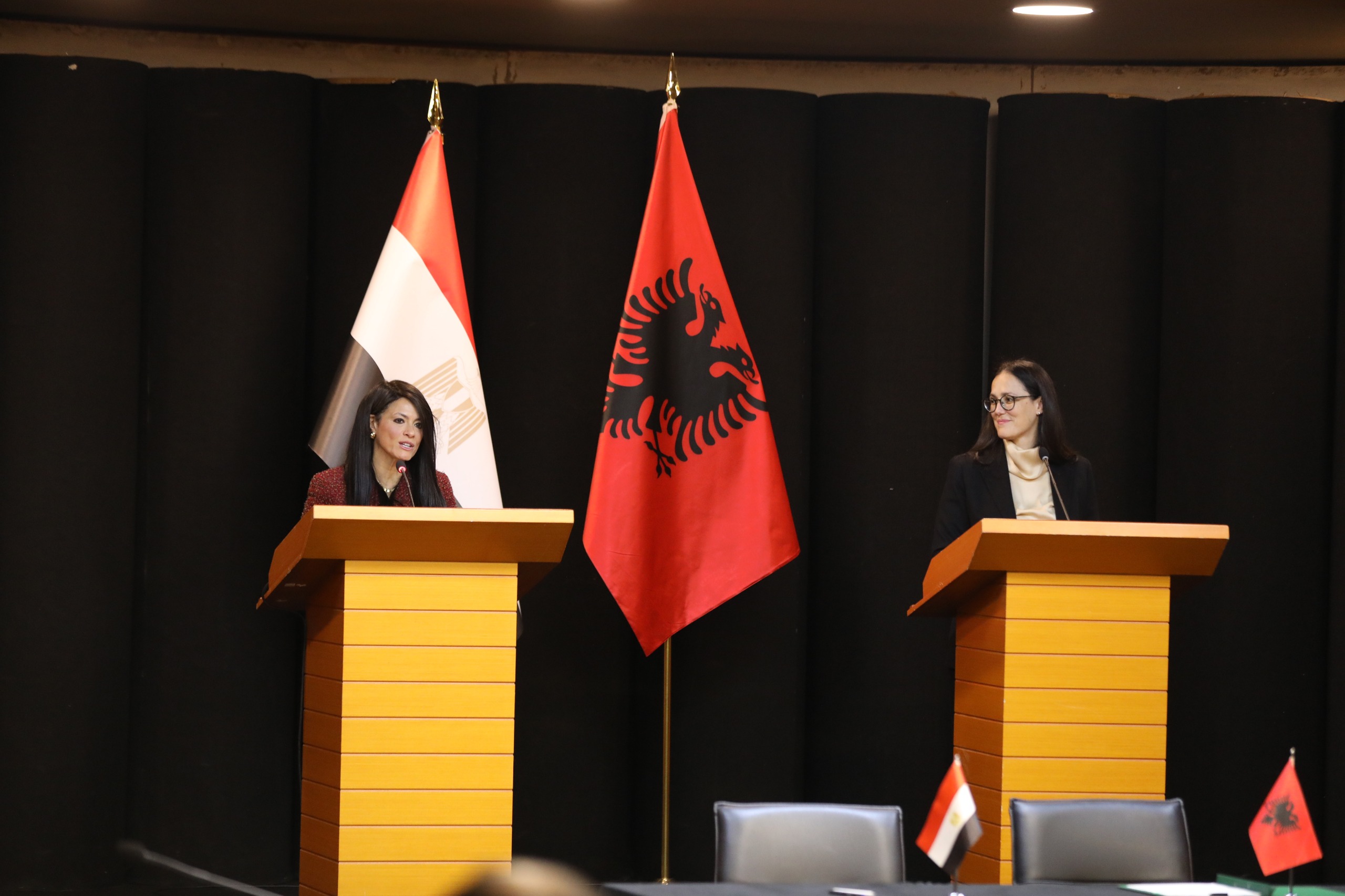
• The convening of the first Egyptian–Albanian Joint Committee reflects the political leadership’s commitment to strengthening cooperation frameworks with various countries
Albanian Minister of Economy:
• Albania and Egypt share long-standing historical relations that we seek to develop to reflect the real opportunities for economic cooperation
• We look forward to achieving tangible outcomes for the economies and peoples of both countries, with investment and trade enhancement as key priorities
H.E. Dr. Rania Al-Mashat, Minister of Planning, Economic Development and International Cooperation, affirmed that the convening of the first session of the Egyptian–Albanian Joint Committee reflects the commitment of both governments to advancing bilateral relations by leveraging the comparative advantages of the Egyptian and Albanian economies and channeling them toward mutual benefit for both peoples through increased trade volumes and joint investments. Her remarks were delivered during the meetings of the Joint Committee and the Business Forum held in the Albanian capital, Tirana.
H.E. Dr. Al-Mashat noted that joint committees constitute one of the most effective tools of economic diplomacy, through which the Egyptian state works to open new horizons for cooperation and explore partnership opportunities with friendly and partner countries.
She emphasized that the prospects for economic, technical, and sectoral cooperation between Egypt and Albania are promising and well-defined, as the complementarities between the two economies provide a solid foundation for expanding partnerships that support shared development priorities.
She further highlighted Egypt’s strategic geographic location as a growing economic hub, particularly through the Suez Canal Economic Zone, Egypt’s extensive network of free trade agreements, and the tangible progress achieved in renewable energy, logistics, and industrial development. These advantages, she explained, offer Albanian partners access to the markets of Africa, the Middle East, and the Arab region.
H.E. Dr. Al-Mashat also pointed out that the Joint Committee and the Business Forum represent valuable opportunities for Egyptian companies to capitalize on Albania’s geographic position as a gateway to Southern Europe and the Western Balkans, enabling Egyptian businesses to access European and regional markets. She added that Albania’s expanding infrastructure networks, proximity to major transport corridors, and progress toward deeper European integration further strengthen its position as an attractive center for investment and trade.
For her part, Ms. Delina Ibrahimaj, Minister of Economy and Innovation of the Republic of Albania, affirmed that Albania and Egypt share long-standing historical relations and a deep-rooted friendship, noting that the Joint Committee represents an important step toward transforming this friendship into practical cooperation that delivers tangible benefits to the economies and citizens of both countries.
She explained that the key priorities include enhancing foreign direct investment and increasing bilateral trade, as well as expanding cooperation across a wide range of sectors, including trade and investment, tourism and cultural heritage, energy and water, agriculture, higher education and scientific research, healthcare and pharmaceutical industries, vocational training, public procurement, industry, housing and urban development, employment, culture, youth and sports, information technology, civil aviation, and maritime transport.
She concluded by stressing the continued coordination with the Egyptian side to translate the outcomes of the Joint Committee into concrete, on-the-ground results, thereby elevating bilateral relations to broader and more ambitious horizons.