• Al-Mashat: Investing in people and artificial intelligence is a cornerstone for enhancing countries’ competitiveness in a rapidly transforming world
• Artificial intelligence has become one of the most important Global Public Goods, underscoring the need to harness it to boost productivity and advance the global economy
• Egypt’s Narrative for Comprehensive Development includes clear pillars linking education to future jobs and enhancing labor market efficiency
• Egypt possesses vast human capital and is working to further develop its innovation and entrepreneurship ecosystem
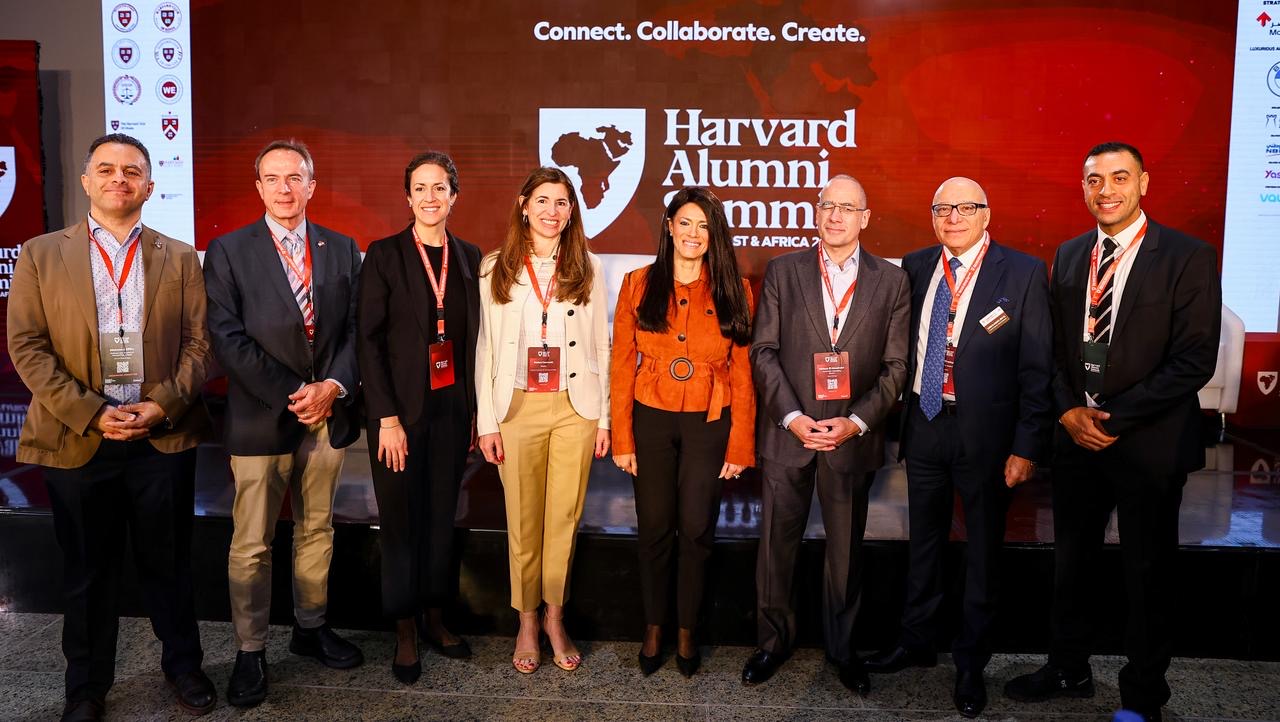
H.E. Dr. Rania Al-Mashat, Minister of Planning, Economic Development and International Cooperation, participated in the Harvard University Middle East and Africa Alumni Summit 2026, held at the Grand Egyptian Museum, with the participation of Mr. Hisham El-Khazindar, Co-Founder and Managing Director of Qalaa Holdings, along with a number of university leaders and alumni from the Middle East and Africa. The summit was held under the theme: “AI Governance and Safety: Building Ethical and Secure Systems in the Middle East and Africa.”
In her keynote address, H.E. Dr. Al-Mashat welcomed Harvard University alumni to the Grand Egyptian Museum, describing it as a civilizational achievement and a global landmark that represents a leading model of multilateral cooperation and Egyptian-Japanese partnership.
She noted that the Grand Egyptian Museum, since its global opening, has successfully generated renewed international interest not only in tourism to Egypt, but also in ancient Egyptian civilization, hieroglyphics, and the timeless knowledge they embody.
H.E. Dr. Al-Mashat explained that the world is undergoing a critical phase of transformation marked by rising protectionist policies and real tests to the multilateral system, which requires countries to strengthen their competitiveness and avoid falling behind by making optimal use of all available resources—foremost among them human capital.
She emphasized that artificial intelligence is not a substitute for human talent, but rather a tool to empower it by increasing productivity, improving job quality, and enabling new forms of value creation. She added that Egypt’s Second National Artificial Intelligence Strategy (2025–2030) places strong emphasis on human capital development and future skills.
The Minister highlighted that international discussions—particularly within the World Bank and International Monetary Fund, as well as the World Economic Forum in Davos taking place this week—are increasingly focused on the concept of Global Public Goods, as a mechanism that enables countries to achieve national objectives while simultaneously contributing to global systems and values. She stressed that these values extend beyond economics to encompass fundamental human principles.
H.E. Dr. Al-Mashat affirmed that artificial intelligence represents one of the most prominent Global Public Goods of our time, noting that empowering people with future skills and jobs constitutes a direct contribution to enhancing global productivity and competitiveness. In this context, she pointed out that Egypt has recently launched Egypt’s Narrative for Comprehensive Development: Reforms for Growth, Jobs & Resilience, which includes a dedicated pillar for labor markets and future jobs, linked to artificial intelligence and centers of excellence.
She underscored that one of Egypt’s most important sources of strength—alongside its rich civilization and strategic location—is its youth, noting that Egypt enjoys a demographic dividend that the State seeks to leverage not only for national economic growth, but also for meaningful contribution to the global economy.
The Minister added that Egypt has a strong innovation and entrepreneurship ecosystem, where entrepreneurs are deploying artificial intelligence across multiple sectors, including fintech, health solutions, and logistics. This has enabled Egypt to achieve a leading position at both the African and regional levels in innovation.
H.E. Dr. Al-Mashat also highlighted that the Ministry of Planning, Economic Development and International Cooperation chairs the Ministerial Group for Entrepreneurship, based on the conviction that startups are a strategic engine for economic restructuring and the creation of high-quality jobs. She emphasized that Egyptian policymakers recognize that economic reform is an ongoing process with no ceiling, requiring the highest levels of transparency and an integrated approach across government entities to ensure effective implementation.
She further addressed the continued improvement in macroeconomic indicators despite regional challenges, noting that economic growth reached 5.3% in the first quarter of the current fiscal year, driven by technology- and labor-intensive manufacturing, information and communications technology—which is a leading contributor to GDP—as well as the rapid expansion of e-commerce. She also noted that Egypt’s tourism sector is currently recording its highest levels ever, with positive growth prospects ahead.
H.E. Dr. Al-Mashat concluded by expressing Egypt’s pride in Harvard University alumni working across diverse fields within the country—including public policy, business, and innovation—renewing her welcome to the participants at the Grand Egyptian Museum and expressing her hope to welcome them again to Egypt in the near future.