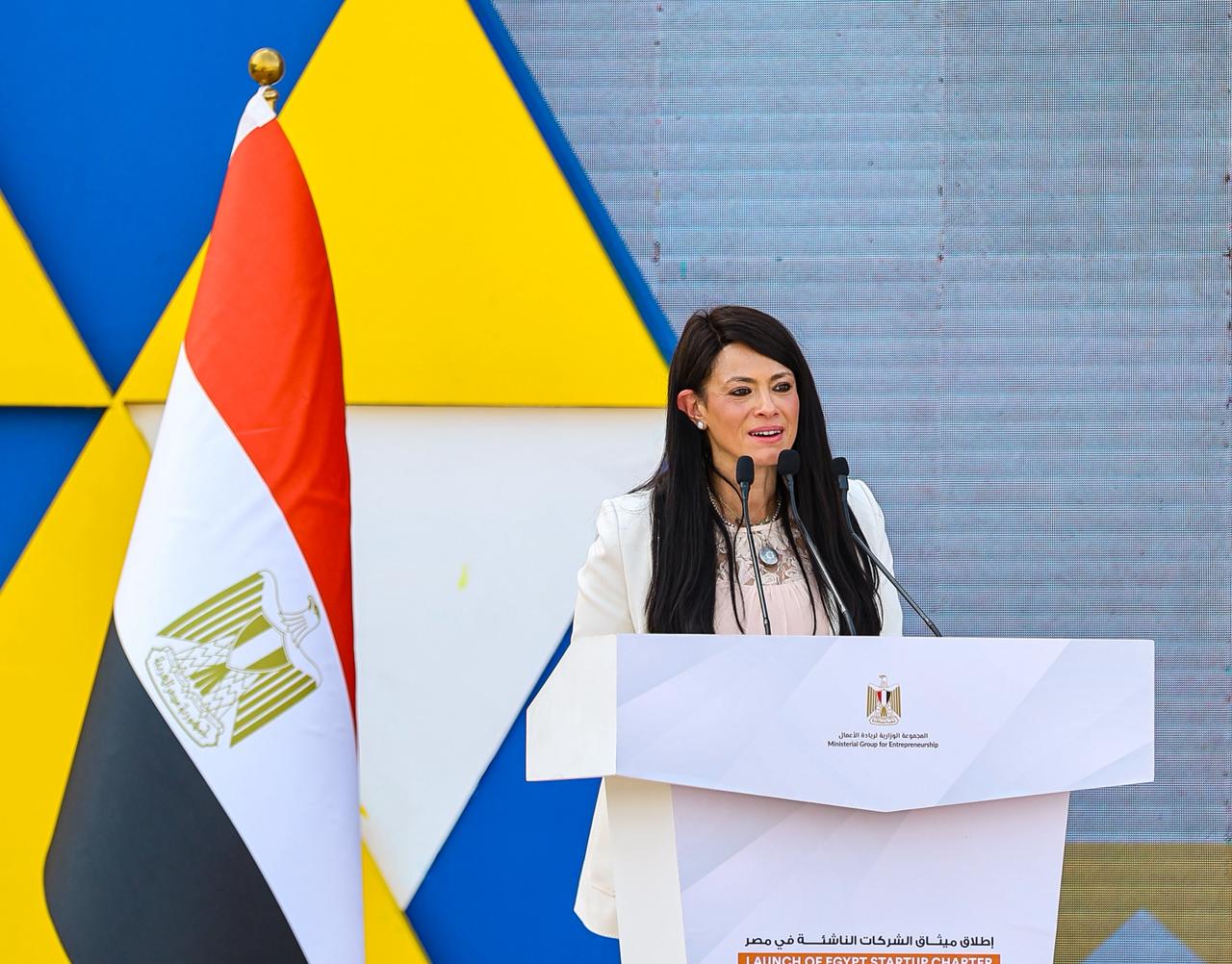
• The Egypt Startup Charter includes a comprehensive package of facilitations and policies for entrepreneurs and innovators
• The Charter focuses on startups at various stages of growth to support national development efforts
• The launch follows a year and a half of intensive work with the participation of all ecosystem stakeholders
• Startups are among the key drivers of economic growth, and the state is committed to providing full support
• Startup Classification Certificates enable companies to benefit from incentives and facilitations
• Egypt’s entrepreneurship ecosystem is continuously evolving, with efforts underway to attract investments from major international institutions
H.E. Dr. Rania Al-Mashat, Minister of Planning, Economic Development and International Cooperation and Chair of the Ministerial Group for Entrepreneurship, delivered the opening keynote at the launch event of the first Egypt Startup Charter, held in the presence of H.E. Dr. Mostafa Madbouly, Prime Minister, ministers who are members of the Ministerial Group for Entrepreneurship, representatives of the House of Representatives, startups, and investors.
H.E. Dr. Al-Mashat explained that the Charter includes a package of facilitations specifically designed for early-stage startups, helping them overcome challenges faced at the beginning of their operations.
She noted that the Egypt Startup Charter incorporates a range of measures that have already been implemented over the past year, in addition to future procedures and legislative amendments aimed at ensuring the continuity of incentive-based policies for the startup sector.
She added that the Charter represents a clear governmental commitment to strengthening the capacity of startups and developing the entrepreneurship ecosystem in a way that delivers tangible economic impact over the next five years. It is not a symbolic document, but rather a flexible and executable framework that evolves continuously and lays the foundation for updating policies and legislation governing startups in Egypt, in line with technological developments and market needs.
H.E. Dr. Al-Mashat highlighted the extensive efforts made to establish a clear and precise definition of startups in Egypt, noting that this definition is the result of sustained work by the Prime Minister’s Office Startup Unit, followed by the formation of the Ministerial Group. The definition was discussed extensively with the entrepreneurship community across multiple sessions before receiving the approval of the Prime Minister and being formally adopted by the Board of the Micro, Small and Medium Enterprise Development Agency in February 2025.
She stressed the importance of the Charter’s startup definition in distinguishing between startups and small and medium enterprises, as each has a different nature—particularly in terms of innovation criteria, growth potential, company age, and reliance on technology or intellectual property. Accordingly, startups require tailored policies, facilitations, and support mechanisms.
Through this definition, early-stage startups are now able to obtain a Startup Classification Certificate, granting them access to a range of incentives and facilitations. She clarified that a startup is defined as a newly established company characterized by rapid growth, flexibility, and innovation, aiming to offer or develop an innovative product, service, or business model in the market.
During her remarks, she reviewed the key advantages offered by the classification, including improved engagement with the Tax Authority and a fully digitalized interaction model with labor offices, social insurance, and tax authorities through a single point of contact, whereby each entity assigns a dedicated liaison to facilitate company procedures.
She added that the new system also introduces financial and procedural incentives for entities supporting classified startups, including incubators and accelerators, thereby strengthening the entrepreneurship ecosystem and reinforcing support networks across different growth stages.
H.E. Dr. Al-Mashat also noted the preparation of a comprehensive government licensing guide for startups under the Egypt Startup Charter. The guide covers 14 priority sectors and includes approximately 170 licenses issued by 35 different government entities. This guide is the result of integrated and collaborative efforts involving the Ministry of Planning, Economic Development and International Cooperation, Entlaq, and UN Women.
She emphasized that early-stage startups are a key source of innovation, while scale-ups reflect the maturity and success of Egypt’s entrepreneurship ecosystem. These companies serve as ambassadors for the ecosystem and represent the most realistic pathway for the emergence of future unicorns, given their ability to attract investment from major international institutions and expand regionally and globally.
She further referred to the unified financing initiative, which aims to coordinate available financing resources across government entities and activate innovative mechanisms to multiply their impact by up to fourfold, targeting the mobilization of USD 1 billion in financing over five years through financial guarantees and co-investments with venture capital funds and other private-sector investment and financing entities.
She explained that the initiative brings together, for the first time, all entities providing direct financing to startups across various stages of growth and development. It also enables the government to identify financing gaps within the startup sector, introduce proactive policy interventions, and enhance returns on investment in startups with greater efficiency and transparency.
H.E. Dr. Al-Mashat concluded by affirming that the launch of the Egypt Startup Charter represents the cornerstone for future efforts and marks the beginning of a more effective contribution by startups to Egypt’s comprehensive development journey—positioning Egypt as a regional platform for entrepreneurship and a leading hub for innovation and creativity.