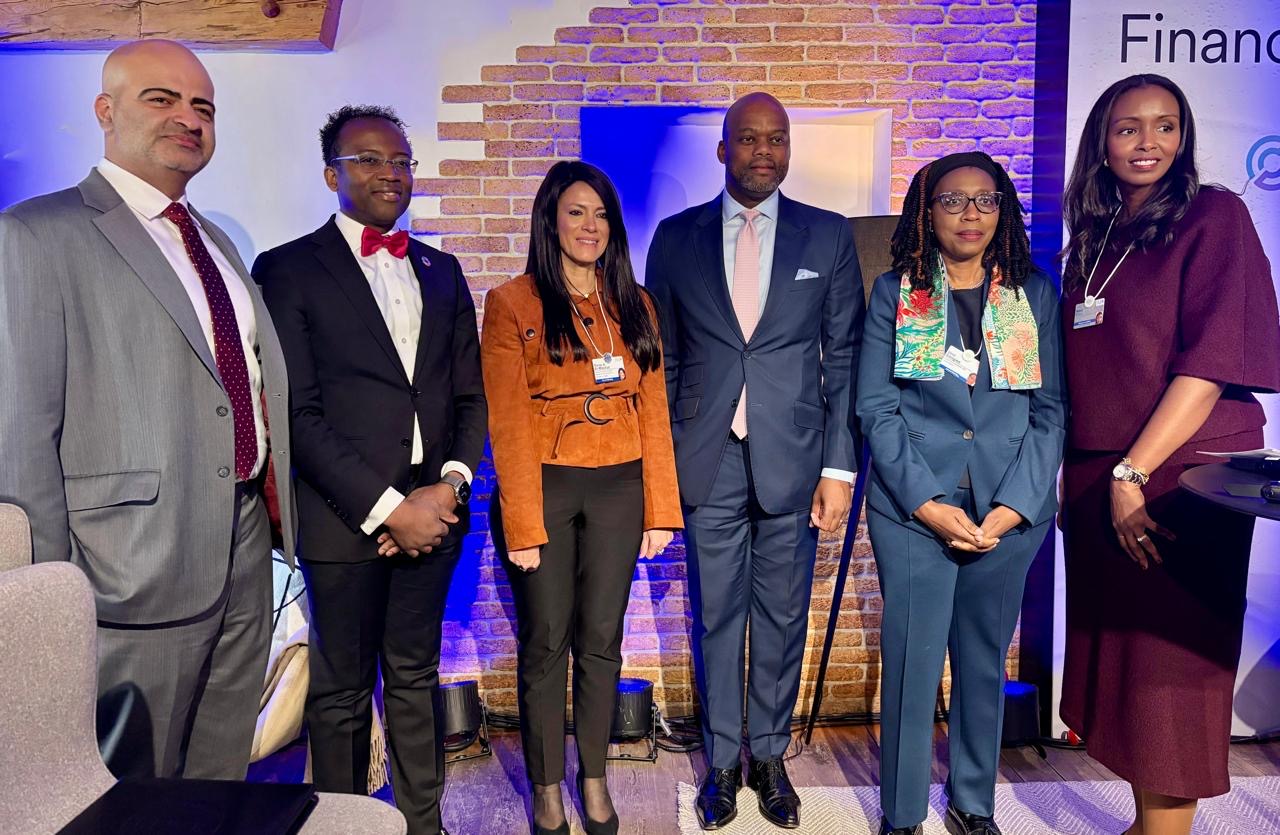
Dr. Rania Al-Mashat:
• Protectionist policies are creating real opportunities for African countries and enhancing their ability to attract industrial investment.
• Intra-African trade remains at low levels that do not reflect the scale of opportunities on the continent.
• We must push the issue of intra-African trade to the forefront of discussions, as it is a core and pivotal pillar for achieving development and creating jobs.
• Egypt continues efforts to overcome challenges and advance economic and trade relations among African countries.
• The Suez Canal Economic Zone is a central pillar of Egypt’s strategy to boost trade exchange and joint investments among African countries.
H.E. Dr. Rania Al-Mashat, Minister of Planning, Economic Development and International Cooperation, participated in a session organized by the Brookings Institution to launch the “Foresight Africa” report and to discuss issues related to trade, finance, and the future of the continent’s economy. The session was held on the sidelines of the World Economic Forum in Davos, with the participation of Mr. Wamkele Mene, Secretary-General of the African Continental Free Trade Area (AfCFTA), along with a number of officials.
In her remarks, H.E. Dr. Al-Mashat emphasized that the protectionist policies we are witnessing today are creating real opportunities for Africa by encouraging companies to shift and reshore their activities within the continent, leveraging Africa’s significant demographic dividend and large market size, particularly its youth population, available skills, and the ability to push the frontiers of industrialization forward through technology.
H.E. Dr. Al-Mashat highlighted that, in the Egyptian context, the economy is transitioning toward a model that capitalizes on the advanced infrastructure developed over the past ten years to create a more competitive economy capable of generating jobs and encouraging industry, investment, and exports. She mentioned that intra-African trade currently ranges between 14% and 17%, which is very low compared to levels seen in the European Union.
H.E. Dr. Al-Mashat pointed out that payment systems play a pivotal role in the success of intra-African trade. In this regard, she praised the role of regional banks across the continent, including the African Development Bank and the African Export-Import Bank, which play a key role by providing financing, guarantees, and facilities to promote trade. However, responsibility is not on these institutions alone, but also on member states, in order to elevate trade as a fundamental and central driver of job creation.
H.E. Dr. Al-Mashat stressed that thinkers, policymakers, and influential stakeholders have a major role to play in advancing this agenda—whether within governments, the African Union, the World Trade Organization, or other international institutions—so as to keep this message alive and affirm that tangible progress has already been made. While the pace of progress may not be as fast as hoped, there are now external factors that can serve as catalysts for greater cooperation and accelerated reform.
H.E. Dr. Al-Mashat commended the efforts of the Ministry of Investment and Foreign Trade, which succeeded in building consensus among African trade ministers within the framework of the African Continental Free Trade Area on rules of origin, particularly in the textiles and garments sector as well as the automotive sector and its components. This enhances intra-African trade and reflects Egypt’s ongoing efforts to achieve development across the continent and promote economic and trade relations among countries. She also noted Egypt’s accession to the Pan-African Payment and Settlement System, which contributes to strengthening economic and trade cooperation among African nations.
H.E. Dr. Al-Mashat also addressed the Suez Canal Economic Zone, the central element of Egypt’s strategy related to the AfCFTA and regional value chains. The zone combines industrial production capacity with world-class logistics services within a single geographic area, facilitating the import of inputs, value addition, and rapid re-export to African markets.
H.E. Dr. Al-Mashat added that the Suez Canal Economic Zone represents the platform that turns “integration” into a commercial reality by reducing time to market and supporting large-scale production of tradable sectors. It also helps Egypt as a competitive hub for aggregation, processing, and transshipment—linking suppliers and consumers across Africa when coupled with digital customs systems and trade facilitation measures.
The Future of Growth
In another context, H.E. Dr. Rania Al-Mashat participated in a high-level session titled “The Future of Growth,” which discussed ongoing transformations in the global economic system, in light of the retreat of a phase of deep uncertainty and the emergence of features of a new economic order to address intertwined global challenges. The session was held as part of the World Economic Forum – Davos 2026, convened from 19 to 23 January.
The session featured high-level participation from senior policymakers and international economic experts, including Dr. Gita Gopinath, Professor of Economics at Harvard University; Dr. Ricardo Hausmann, renowned global economist and Founder and Director of Harvard University’s Growth Lab; as well as prominent academics from international universities and research centers, and heads of global financial institutions and companies. The session was moderated by Ms. Saadia Zahidi, Managing Director of the World Economic Forum.
H.E. Dr. Al-Mashat reaffirmed that the discussions highlighted declining levels of preparedness for economic resilience globally, stressing that resilience is no longer a defensive concept, but rather a fundamental requirement for attracting investment and enhancing productivity and competitiveness.
H.E. Dr. Al-Mashat reviewed the ongoing transformation in Egypt’s economic growth trajectory, underscoring that growth is no longer measured solely by GDP expansion rates, but by the quality, sustainability, and structure of growth. She noted that the Egyptian economy is transitioning from a model that relied heavily on government investment in infrastructure to a growth model based on productivity, economic complexity, and value creation.